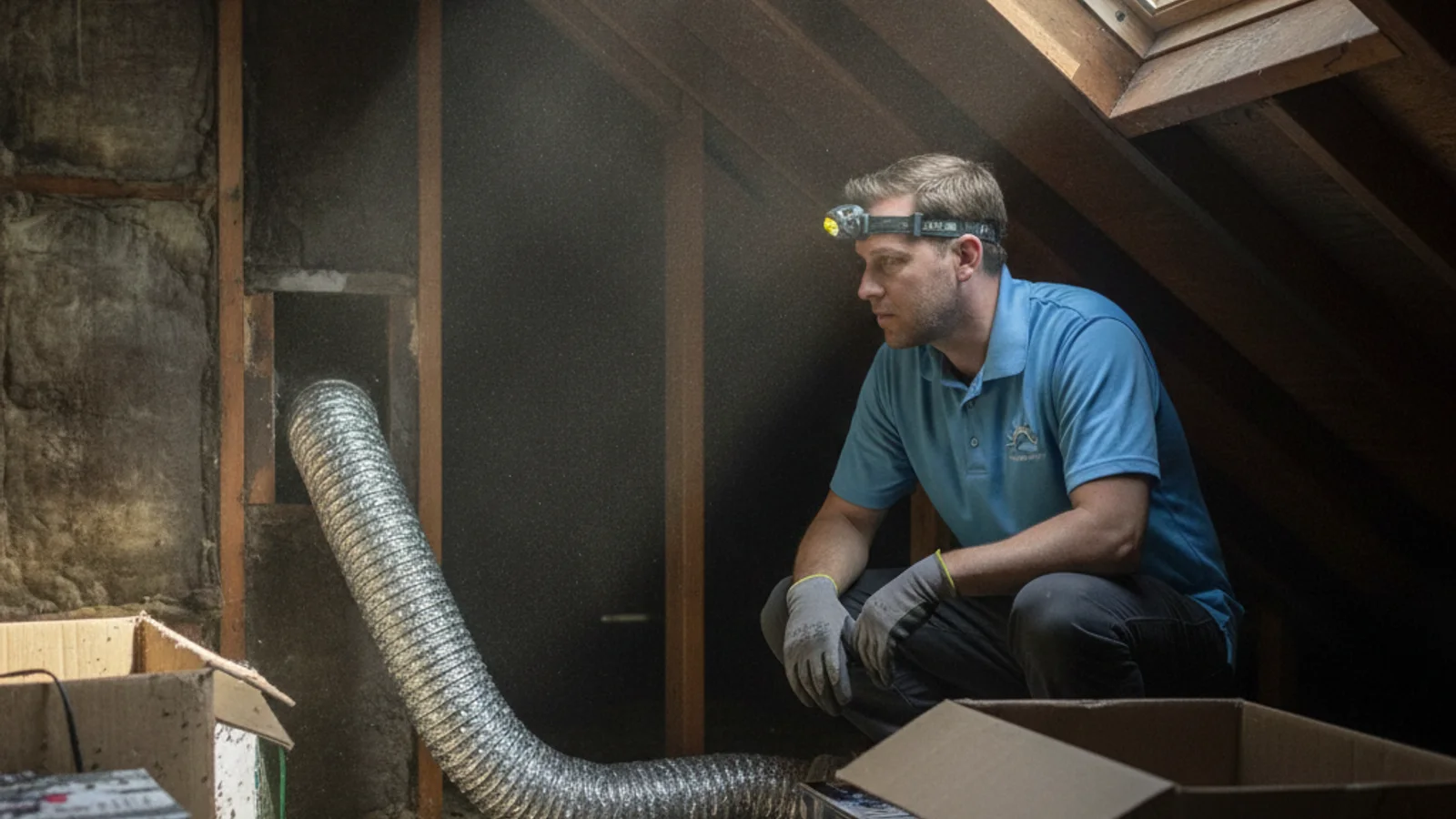
A bathroom exhaust fan that vents into the attic instead of outside dumps moisture directly into the attic space, and adding a skylight or solar tube in the same room doesn’t fix that separate problem. It’s a different issue, with a different fix, and it’s worth understanding on its own.
How this happens in the first place
Running a bathroom fan duct all the way to a roof or soffit vent takes more work than running it a short distance into open attic space. In older construction, and in some remodels done as a shortcut, the duct simply terminates a few feet into the attic instead of continuing out through the roof or eave. It looks finished from inside the bathroom. The fan runs, the noise sounds right, and nobody notices the duct never actually reaches the outside.
This isn’t unique to any one era of construction, but it shows up often enough in homes that have had a bathroom remodeled at some point without a full inspection of the ductwork above the ceiling line.
The moisture risk, described plainly
Every shower and bath sends a meaningful amount of water vapor into the air, and a properly vented fan is what carries that moisture outside the house. When the duct dead-ends in the attic instead, that same moisture gets released into an enclosed space with wood framing, insulation, and roof decking. Over time, repeated exposure to that moisture creates the kind of damp conditions that support mold growth and can affect roof decking and framing. This isn’t a reason for alarm over a single shower. It’s a reason to fix the duct routing once it’s identified, rather than let it run that way indefinitely.
Why this often gets caught during a daylighting quote
Here’s where this connects to skylights and solar tubes at all: an installer assessing your attic for a solar tube run or a skylight light well is already up there, often getting a closer look at the attic than most homeowners ever do. It’s common for a duct terminating in open attic space to get spotted during that inspection, simply because the installer is looking around the exact area where a bathroom fan duct would be running.
If you’re getting a quote for a solar tube installation or a skylight and the technician mentions the bathroom fan duct doesn’t appear to reach the outside, that’s worth taking seriously even though it has nothing to do with the daylighting product itself.
Why it needs its own fix, not a bundled one
Rerouting bathroom fan ductwork to a proper roof or soffit termination is HVAC or general-contractor work. It isn’t something a skylight or solar tube installation addresses, and it shouldn’t get folded into that job as an afterthought. The two projects use similar attic access but are functionally separate scopes of work, done by different trades, and each deserves its own proper fix rather than a quick patch tacked onto an unrelated install.
A simple check a homeowner can do without going into the attic
You don’t necessarily need to climb into your own attic to get a first read on this. Run the bathroom fan for a few minutes and go outside to look at the roof or the nearest exterior wall for the vent cap that should correspond to it. If you can find a roof cap or wall vent and can feel or see airflow coming from it while the fan runs, that’s a reasonable sign the duct is terminating outside as intended. If you can’t locate any exterior vent that seems to match, or the fan runs with no detectable exterior airflow anywhere nearby, that’s worth flagging to a professional for a proper attic-side check rather than assuming everything is fine.
What to ask your installer to flag
If you’re already having a solar tube or skylight quote done, it costs nothing to ask the technician to note where your bathroom fan duct terminates while they’re in the attic anyway. If it turns out the duct doesn’t reach the outside, ask for a straightforward description of what they saw, not a fix bundled into the daylighting quote. From there, a general contractor or HVAC technician can reroute the duct properly, typically to a dedicated roof vent or a soffit vent designed for exhaust air, separate from any passive attic ventilation already in place.
The difference between passive attic ventilation and active exhaust venting
It’s worth being clear about what a bathroom fan is actually supposed to do, since it’s often confused with general attic ventilation. Passive attic ventilation, through soffit vents and a ridge vent or gable vents, is designed to move air through the attic space itself to manage overall heat and moisture. A bathroom exhaust fan is a completely different system, designed to actively pull humid air out of a specific room and expel it entirely outside the building envelope. A mis-routed fan duct doesn’t just fail to help; it actively works against the attic’s passive ventilation system by injecting concentrated moisture directly into a space that’s only designed to handle ambient conditions, not a steady stream of bathroom humidity.
What proper rerouting typically involves
Once a mis-routed duct is identified, the fix usually involves extending or rerouting the existing ductwork to a dedicated exterior termination point, either a roof cap vent or a soffit-mounted exhaust vent built for that purpose. The specific approach depends on the distance from the fan to the nearest usable exterior point and how much of the existing duct run can be reused versus replaced. This is a straightforward job for an HVAC technician or general contractor familiar with bath fan venting, though it does require getting into the attic and sometimes working around existing insulation, framing, or other ductwork already up there.
Older homes and remodeled bathrooms
This issue tends to concentrate in two kinds of situations: older homes where the original bath fan was installed before venting-to-the-outside became a more consistently enforced standard, and remodeled bathrooms where a new fan was added or an existing one relocated without a full ductwork review. In both cases, nobody set out to create a problem. It’s simply a detail that’s easy to overlook when the visible parts of the job, the fan itself and the switch, both function correctly and give no obvious sign that the duct behind the wall never reaches outside air.
Why this matters more in Austin specifically
Austin gets roughly 35.8 to 36.4 inches of annual rainfall spread across meaningful humidity swings through the year, on top of an attic that already runs 120 to 150 degrees at peak summer. That combination of summer heat and real seasonal humidity is exactly the environment where a mis-routed bathroom fan duct does the most damage over time, since the attic is already working hard against both heat and moisture without an extra, unnecessary source added to it.
How do I know if my bathroom fan vents into the attic?
The most reliable way is a visual check from inside the attic, tracing the duct from the fan housing to see where it actually ends. Some homeowners also check from outside by looking for a roof or wall vent cap that should correspond to the bathroom fan; if you can’t find one anywhere near the bathroom, that’s a sign worth investigating further.
Does this cause mold quickly, or over years?
It’s typically a gradual issue rather than an immediate one. A single mis-vented fan doesn’t cause overnight damage, but repeated moisture exposure over months and years is what creates the conditions for mold growth and wood damage in the attic. That timeline is exactly why it’s worth fixing once identified rather than leaving it alone.
Will fixing the vent path affect my skylight or solar tube installation?
No, they’re separate projects that happen to share the same attic space. Rerouting the fan duct doesn’t interfere with a skylight light well or a solar tube run, and either project can proceed on its own schedule regardless of when the duct issue gets addressed.
Getting the whole attic looked at right
If you’re already planning a skylight or solar tube project, it’s a reasonable moment to have the attic looked over more broadly, not just where the new install goes. Bright Sky ATX connects Austin homeowners with experienced, insured local crews for solar tube installation and skylight installation alike. Call (737) 477-8898 for a free estimate.