No. A sun tunnel is not the same as a skylight. A sun tunnel is a small roof dome, a reflective tube through the attic, and a round diffuser in the ceiling. A skylight is a glazed window built into the roof. They both bring daylight into an Austin house, and that is the only thing they share.
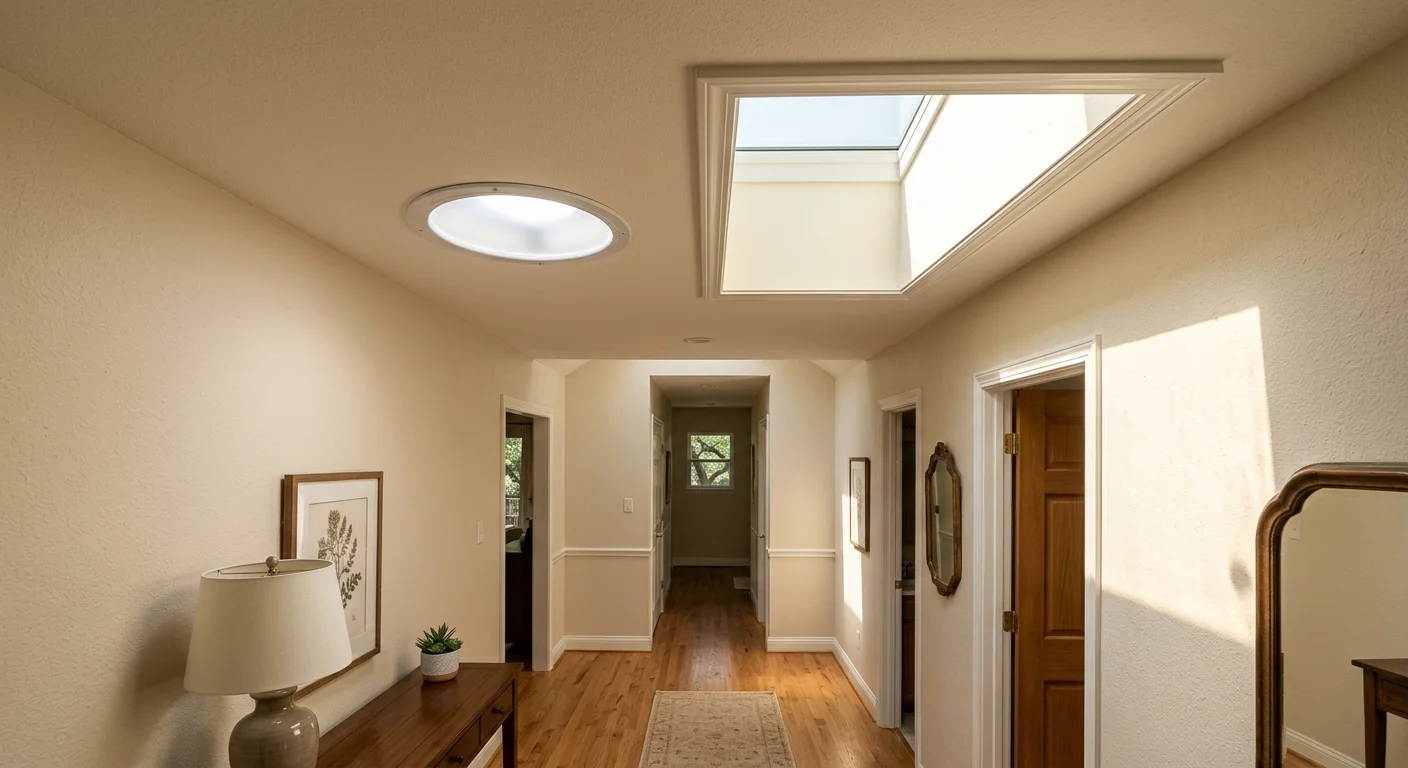
How a sun tunnel differs from a skylight
Stand in a Hyde Park bungalow or a one-story ranch in Pflugerville and look up. The difference is on the ceiling. One finish is a round lens. The other is a rectangular well, often with a view of clouds.
A sun tunnel is a tubular daylighting device. People in Travis, Williamson, and Hays counties also call it a solar tube. The roof piece is a low dome. A rigid or flexible tube runs through the attic. A diffuser spreads light into the room. You do not look through it. You do not crank it open. It is not a window.
A skylight is a window in the roof. The glass sits on a curb or on the roof deck. You can see sky. Some units vent. Some take interior shades. The hole in the roof is larger. The ceiling opening is a framed well, not a pipe.
Brand names make this messier than it should be. One maker calls its tube a Sun Tunnel. Another sells a solar tube under its own name. Homeowners then use sun tunnel, solar tube, and skylight as if they named one object. They do not. Are sun tunnels the same as skylights? No. Sun tunnel vs skylight is a product-class split, not a nickname split.
The identity test is short. If the unit is glass in the roof plane, it is a skylight. If daylight travels down a tube to a ceiling diffuser, it is a sun tunnel. Same daylight job. Different object on the roof, in the attic, and in the room.
For a plain definition of the tube itself, read what a sun tunnel is. For when each product fits an Austin house, read solar tube vs skylight in Austin. This page stays on the sameness question: they are not the same thing.
What each one does to an Austin roof
Austin roofs are not one surface. Asphalt shingle is common in the urban core, East Austin, and the north corridor through Round Rock and Cedar Park. Standing-seam metal shows up in the Hill Country west, from Bee Cave out through Dripping Springs in Hays County. Tile sits on some south Austin and Circle C roofs. Each surface takes a different flashing kit.
A sun tunnel cuts a small round hole. The dome sits low. The flashing is a pipe-style kit made for that roof, not a large curb. On a tight attic in Allandale or Crestview, the tube still has to miss trusses, ducts, and a water heater. The roof work is real. The penetration is just smaller.
A skylight needs a bigger opening. Curb-mount units sit on a built curb. Deck-mount units sit closer to the shingles. Either way, the contractor cuts sheathing, frames the hole, and weaves flashing into the roof course. On metal, that flashing has to match the panel. On tile, the tile around the unit has to be cut and reset. That is a different day of work than setting a dome.
Hail belongs in this picture. The September 24, 2023 Central Texas hailstorm was the costliest Austin-area hailstorm on record. Round Rock saw hail up to about 4 inches. Losses in Travis and Williamson counties were estimated at about $600 million combined. A glass skylight and a plastic tube dome do not take a hit the same way. After a storm, each opening needs its own look. Do not assume a tube is not a roof opening.
Energy rules attach to the product, not the nickname. City of Austin residential energy code uses Climate Zone 2. For skylights, the published maxima are U-factor 0.60 and SHGC 0.28. A matching published figure for sun tunnels could not be confirmed in those same tables. Confirm the current rating on the product sheet. Then have the contractor check the unit against your roof and attic on site.
Rooms where the two are not interchangeable
They are not swap-in replacements. The room decides, and Austin rooms are not interchangeable either.
Hallways, powder rooms, walk-in closets, and interior baths in a Round Rock or Cedar Park two-story often have no exterior wall. A sun tunnel can run from the roof, through an attic, to a small ceiling. A full skylight in that same hall would mean a large well and a hole you may not want over a narrow space. That is why sun tunnel installation and solar tube installation show up in interior rooms first.
Kitchens and living rooms are a different ask. If you want a view of sky over a table in Tarrytown, or a sense of height in a South Congress bungalow, a tube will not give you that. A skylight will. If the kitchen is a galley with a long dark run and a busy attic above, a tube may be the unit that actually fits. Wanting daylight is not the same as wanting a window in the roof.
Home offices care about glare. A skylight can take a shade. A sun tunnel’s diffuser spreads light and cuts a hard beam, but you cannot treat it like a window you dim unless the maker sells a kit for that model. Check the sheet. Do not assume a dimmer exists.
Showers add moisture. Either product can sit over a bath if the ceiling, the vapor, and the flashing are handled. A vented skylight can dump humid air. A sun tunnel cannot vent a room. If the bath has no other exhaust, a tube does not replace a fan.
Attic conversions and bonus rooms in older Travis County houses sometimes want a roof window for egress. A sun tunnel is not an egress opening. It is not a roof window. If a room needs a way out, you are shopping a different product.
HOAs in Steiner Ranch, Circle C, and similar west-side neighborhoods often review roof changes. A small dome and a large glass unit do not look the same from the street or the greenbelt. Ask what the association actually reviews before anyone cuts shingles.
Heat, leaks, and light in plain terms
Austin heat is the filter on every daylighting choice. Summer attic air is harsh. A tube is a sealed, reflective path. A skylight is a glazed opening with a well that can also move heat if the glass and the shades are wrong.
Do not treat a tube as automatically cooler. Do not treat a skylight as automatically hotter. Glass coatings, shades, tube length, roof color, and attic insulation all matter. The U.S. Department of Energy lays out the broader heating and cooling picture for homes at energy.gov. For rated skylight products, ENERGY STAR publishes the current product criteria. Texas program context sits with the State Energy Conservation Office.
Specific lumen counts, tube diameters, and sun-tunnel heat ratings could not be confirmed for this page. Read the manufacturer’s sheet for the exact unit. Then have an independent installer measure the roof pitch, the attic path, and the room. A number copied from a national brochure is not a measurement of your house in Travis, Williamson, or Hays County.
Leaks follow flashing, not folklore. Both products pierce the roof. Both fail when the flashing is wrong, the seal is old, or wind-driven rain finds a gap. Central Texas storms drive rain sideways. A low dome and a raised curb shed water on different paths. Neither one is the leaky one by name. The leaky one is the one flashed for a different roof, or left alone for years.
Light is why people mix the names. Both make a dark room usable in the day. A skylight gives a view and a beam you can see move. A sun tunnel gives a pool of daylight with no view. If you are choosing on identity, that is the split. Brightness is a later question, and it only makes sense after someone has seen your attic.
The federal 25C credit expired for installs after December 31, 2025. Do not plan a tax number into the job. Confirm any current incentive with the contractor and the agency that still administers it, if any still does.
How to choose with an independent installer
Bright Sky ATX is a referral service. It matches homeowners in the Austin metro with experienced, insured independent skylight and daylighting pros. It does not install, own trucks, or set prices. You contract with the pro directly.
Bring the identity question to the roof, not to a catalog. Ask the contractor to point at the actual object they would put on your shingles, metal, or tile. If they say skylight and then hold up a tube kit, stop and rename it. You cannot compare quotes if the names are mixed.
Walk the attic. A tube needs a path. A skylight needs a well. Some 1970s ranches in Williamson County have a clear run. Some 1940s houses in central Austin do not. A photo of a dome on a website will not tell you which one you have.
Match the room to the object. Interior bath, hall, closet: start with a sun tunnel. Room where you want sky, air, or a shade: start with a skylight. Room that needs egress: neither of those two, until someone confirms a roof window is even on the table.
Ask what the City of Austin or the county will review for your address. Rules differ inside city limits, in the ETJ, and out in Hays or Williamson. The contractor you are matched with should name the jurisdiction. A shrug is not an answer.
Ask for the product sheet, the flashing kit for your roof type, and a plain yes or no on whether the unit is a window or a tube. If a spec is missing from the sheet, it could not be confirmed from here. Confirm it on paper and on the roof, in that order.
When to call us
Call when a roof opening has to be named correctly before anyone cuts it, or when a dark interior room and a view-of-sky room are being treated as the same job. That is skylight and daylighting work for an experienced, insured independent pro, not a weekend patch. Call us at (737) 477-8898 and we will match you with a licensed local pro.