The best direction for a skylight in Central Texas is the roof plane that fits the room, the heat, and the hours you use that space. South and west bring the strongest sun. North and east stay softer, and an independent installer should still confirm the opening after they see the roof and attic.
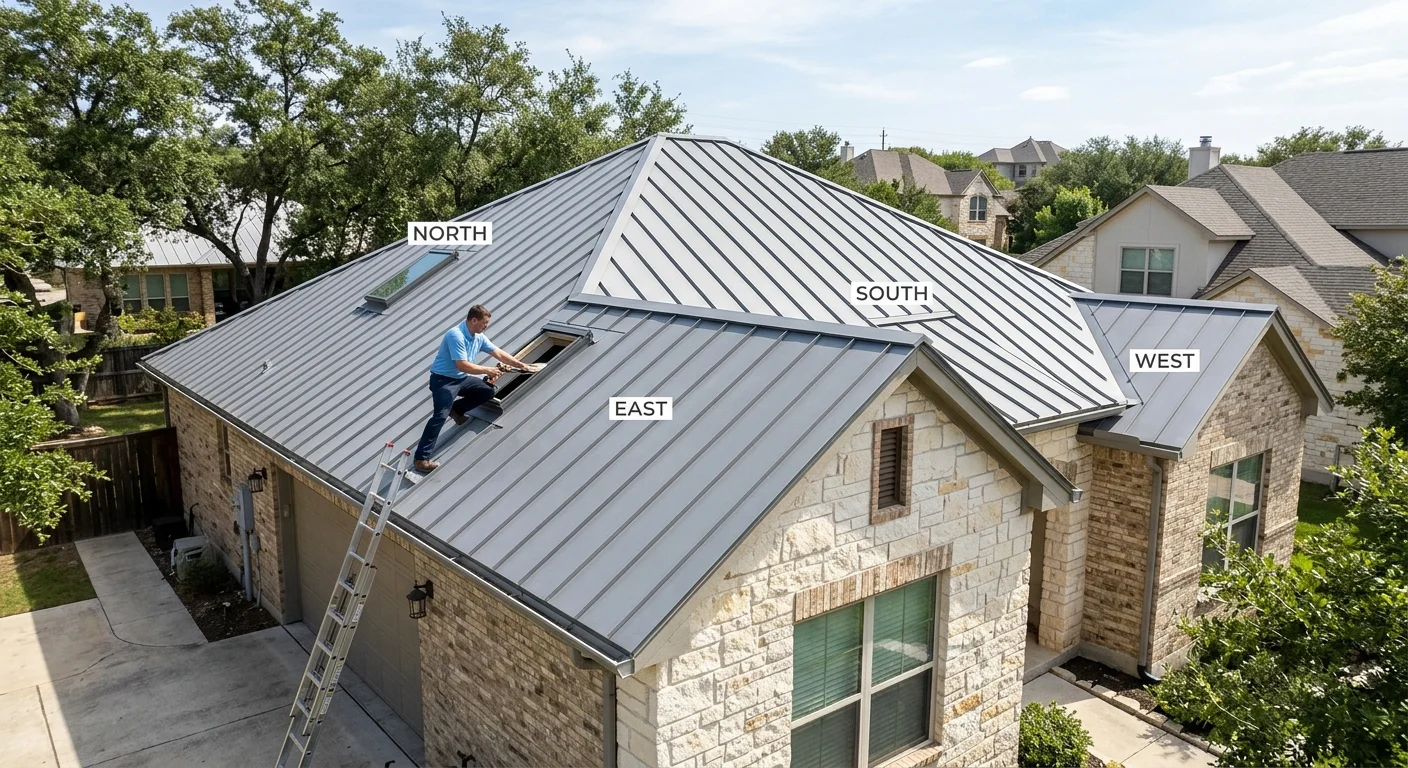
How north, south, east, and west light differ
Austin sits in the Northern Hemisphere, so the sun spends the day on the south side of the sky. Advice written for the Southern Hemisphere does not apply here. On a Travis, Williamson, or Hays County roof, south is the long-sun plane.
A north-facing skylight almost never takes a direct beam. You get even light from morning through late afternoon, with less glare on counters and screens. That makes north a strong match for Austin heat. On a stretch of gray winter days, north light can feel quiet. It rarely feels harsh.
A south-facing unit sees the most sun of the four. Winter sun sits lower and reaches deeper into the well. Summer sun sits high and loads the glass for hours. In a cooler climate that extra heat is useful. In Austin it is a cooling load unless the glass and shades are chosen for it. Family rooms and open kitchens can handle south light if you plan for that load.
East light is a morning event. The sun is weaker then, and the attic has not stored a full day of heat. Breakfast rooms, east bedrooms, and baths you use at dawn fit this plane. You will not get even light all afternoon. If morning is the point, east is the right call.
West light arrives when Austin is already hot. The beam is lower and more direct than noon sun on a south slope. A west plane on an open lot in Bee Cave or along Loop 360 can punch a living room after 3 p.m. Live oaks in Hyde Park or Allandale sometimes cut that same beam. Walk the lot in late afternoon before you pick west.
Skylight orientation is the slope the unit sits on, not the wall the room faces. A south-facing kitchen can still receive a north skylight if that is the roof above it. The contractor you’re matched with reads both the compass and the actual planes.
Why roof pitch changes the result
Roof pitch changes how much sky the glass sees, and how fast water leaves the flashing. A steep south slope looks more toward high summer sun. A shallow south slope takes more of the low winter beam, and more of the late-day glare. Two houses on the same street can need different glass if one roof is a low bungalow in Hyde Park and the other is a steep metal roof in the Hill Country.
You may hear that skylights need about 15 degrees of pitch, or that slope should track latitude plus a few degrees. Those rules of thumb are not in Austin’s published energy tables, and a local minimum pitch could not be confirmed there. What does matter is the real slope underfoot. The pro who inspects the roof picks a deck-mount or curb-mount flashing kit that matches that slope. Low-slope and flat roofs usually need a curb so water can move around the unit instead of sitting on the pane.
Stay off roof valleys and eaves when you can. Leaves, shingle grit, and hail fragments collect there, and water lingers at those seams. That is not a claim about where most units fail. It is why installers like a clean field of roof, a bit higher on the plane, with a clear path for drainage. Higher placement also tends to see more sky.
Framing decides the hole as much as the compass does. Stick-framed roofs often leave a bay that already fits a common skylight width. Truss roofs are tighter. Cutting a truss is a structural decision, not a daylighting one. The inspection should map rafters or trusses, ducts, and vents before anyone marks an opening. If the bay you want is blocked, a smaller unit, a shifted location, or a solar tube may be the honest answer.
How Austin heat affects glass and shade choices
Austin’s residential energy code uses Climate Zone 2. For skylights, the published maxima are a U-factor of 0.60 and an SHGC of 0.28, in both the existing-building and new-construction tables. Those numbers cap how much heat the glass can pass. They do not pick your direction. A west unit that meets the cap can still feel fierce at 5 p.m. if you leave it unshaded.
Read more on skylight glazing and SHGC in Austin heat. South and west openings want lower solar heat gain. North is the easier thermal plane because it sees little direct sun. East sits in the middle. Confirm the stamped ratings on the unit the contractor proposes.
ENERGY STAR publishes product criteria for skylights. Use that as a shopping filter, then match it to Austin’s table. The U.S. Department of Energy explains how extra solar gain shows up as cooling load. Here, that load is a summer problem. Winter warmth through a south skylight is real. It is not the season that usually drives the complaint.
Shades keep a south or west opening livable. Skylight blinds and shades cut glare and keep the late-day beam off a sofa. A venting unit can dump hot air at the ceiling. That helps a west room that stacks heat in the well. None of it replaces sound flashing.
Hill Country lots west of Loop 360 often have more west sky and less street-tree cover. Hyde Park, Allandale, and parts of East Austin often have canopy. The same west product can behave differently on those two roofs.
What room use tells you about placement
Where to place a skylight starts with the hours you occupy the room. Direction is the next filter. Framing is the last.
Kitchens want even light on the worktop. North or east keeps a hot patch off the island. South can work in a dark interior kitchen if shades are in the plan. West is the dinner-hour glare problem, especially if the sink faces that beam.
Home offices want north light. Direct sun on a screen is the failure mode. If the only available plane is south or west, shades are not optional.
Bedrooms split. East helps you wake. North stays calm for people who sleep late or work night shifts. West can keep a room bright and warm past sunset in June, which some people like and others do not.
Baths can take a smaller unit and frosted or patterned glass for privacy. A skylight over a shower is a wet-room detail, not just a compass choice. Hallways, interior baths, and walk-in closets often do not deserve a full curb. That is tube territory.
Living rooms can take south light if you want the room to feel open all day. Pair it with shades. If the room is a TV space, north or east is kinder.
When you can, line the well with the windows on the wall below. The room reads as one volume instead of a hole in the ceiling. That is a look issue, not a code issue. It still helps.
None of this overrides the attic. A beautiful west living-room idea dies if a trunk line or a truss sits in the well. Skylight installation starts with that inspection. Bright Sky ATX matches you with an experienced, insured independent pro. You contract with that pro directly.
When a solar tube fits better
A solar tube (also sold as a sun tunnel) is a better answer when the roof plane you want does not sit over the room you need to light. The dome lives on a clear roof slope. A reflective tube carries the light to a ceiling diffuser. You do not need a large well through a deep attic.
That helps bungalows in Hyde Park and Allandale, where the attic is tight and the hallway is dark. It helps an interior powder room that will never have a window. It helps a truss bay that cannot take a wide curb without a structural redesign.
Tubes give you less view of the sky and less sense of a room opening up. They also give you less of the heat and glare that a big south or west pane can dump. For a closet, a stair, or a dark bath, that trade is usually the right one. For a kitchen you want to feel tall, a framed skylight is still the better tool.
Read solar tube vs. skylight in Austin before you lock the opening. If both could work, ask the installer to stand in the room at the hour you care about, then go onto the roof and show you which plane would feed a curb and which would feed a tube. You cannot rotate a finished skylight to a new direction later. You can add shades and you can change glass. The compass of the hole is the decision that stays.
When to call us
A new opening in a roof is not a guess from the street. This is the point to bring in an experienced, insured independent skylight and daylighting installation pro to inspect the roof, attic, and framing. Call us at (737) 477-8898 and we will match you with a local pro.