A custom skylight in Austin is a unit built for an opening a factory catalog size will not fill. Hyde Park bungalow rafter bays, Hill Country metal ribs, and low-slope south-side additions are the usual reasons a stock curb will not sit true, and Bright Sky ATX matches you with independent, insured local pros who measure that opening before you buy.
What makes a skylight custom
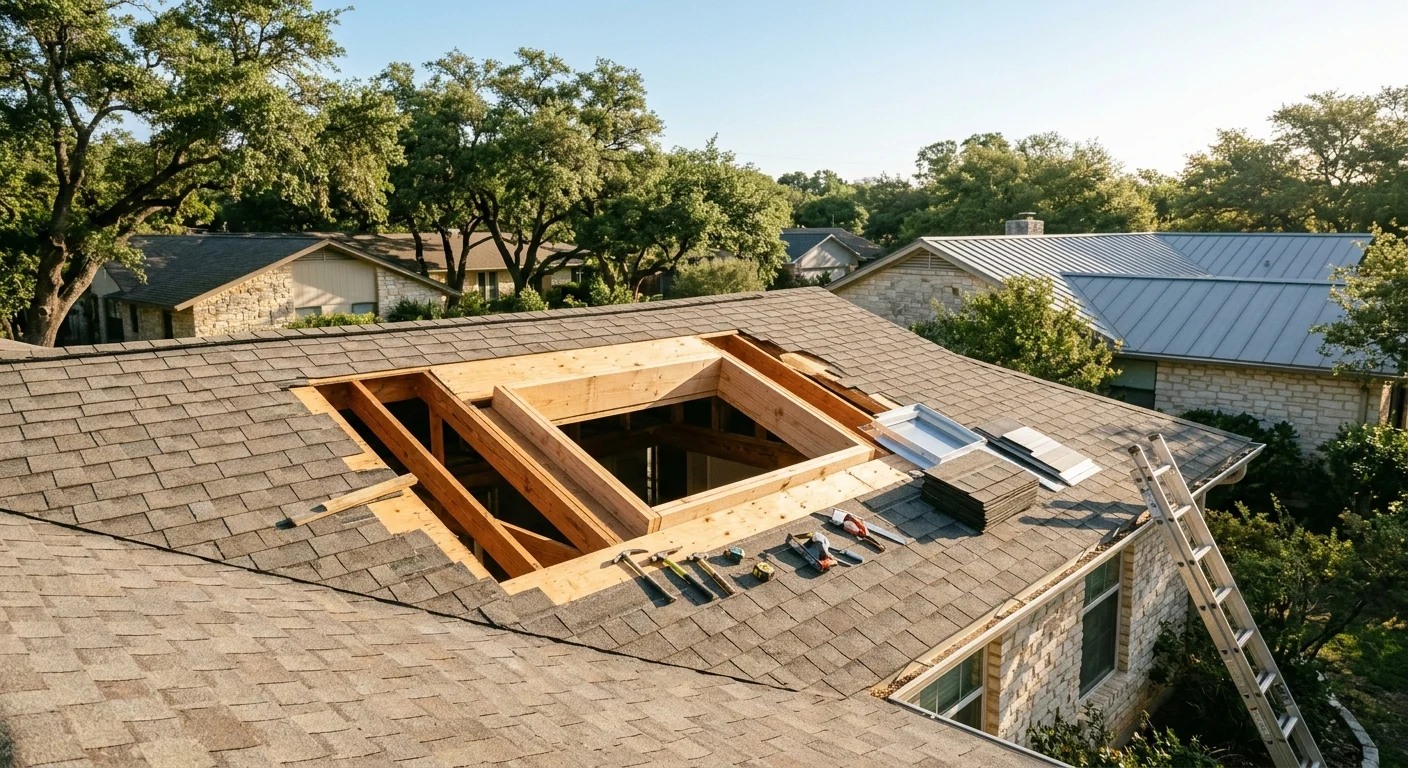
A catalog skylight is a factory size. The glass, curb, and flashing kit ship as a matched set. A custom unit exists because that set will not match the hole in your roof.
Custom is about geometry, not nicer glass. A vented sash or a rain sensor on a listed size is still a catalog unit. Custom starts when the opening, the roof plane, or an old curb forces a unit that is not in the published grid.
On a Hyde Park or Allandale bungalow, rafters can sit closer than a stock width. The ceiling well downstairs may already be framed to a rectangle no manufacturer lists. West of the city, a standing-seam Hill Country roof can need a flashing pan formed for that rib pattern. South Austin low-slope additions can sit under a pitch a standard kit is not made to wrap.
Skylight installation still happens either way. The contractor you’re matched with either orders a listed size or sends measurements for a special size. Bright Sky ATX does not build the unit and does not set it. You pay the independent contractor.
A roof window follows the same split. If the attic and the well take a listed sash, stay with catalog. If the well is already there and the numbers don’t match, that window is custom too.
Ask the contractor to put custom on the right line. Special-order glass is one thing. A site-built wood curb is another. A standard flashing kit on an odd curb is a third. Those three should not share one blurry line on the quote.
When a catalog size will not work
A listed size fails when the rafter bay is too narrow, too wide, or out of square. It also fails when an old curb is still usable and isn’t a listed inside dimension. A valley, hip, stack, or HVAC line can steal the only catalog-friendly bay.
If you’re weighing whether you can add a skylight to any roof, the short version is this. Many roofs in Travis, Williamson, and Hays counties can take a unit. The size of the opening is what turns the job custom.
North corridor truss roofs in Round Rock, Cedar Park, and Pflugerville often repeat the same bay. A catalog unit can land there after a header, when the attic and the roof covering allow it. Central-city bungalows from the 1920s and 1930s were stick-framed, and the bays wander.
If a leaky unit is coming out and the wood curb is square, dry, and a listed size, a replacement may drop in. If the curb is out of square, or the glass is a size nobody stocks, the replacement becomes a custom order or a new curb. Don’t assume the sticker on the old glass is still a current catalog size. Manufacturers retire sizes.
Valleys on a Crestview or Rosedale cross-gable can sit too close to the only bright room. The contractor may shift the opening, or tell you the room is a better candidate for a tube. That call belongs on the roof and in the attic.
Don’t pick a size from the living room. The attic tells you the clear width between rafters. Until both the attic and the roof plane are measured, a catalog promise is a guess.
How Austin roofs change the opening
Austin is not one roof. The urban core, the north corridor, the Hill Country west, and the south additions do not take light the same way.
Hyde Park, Allandale, Rosedale, and Travis Heights mix bungalows and later additions. The original plane can be steep composition shingle. The addition can be a lower pitch with a different deck. A unit that fits the old bay may not flash on the addition.
West of MoPac, standing-seam and other metal roofs are common on Hill Country houses. Ribs and seams change where a curb can land. A metal roof skylight in Austin needs flashing that follows that panel, not a shingle kit with the corners folded down. That flashing is often the custom part even when the glass is a listed size. Name that split on the quote.
Low-slope additions show up along South Lamar, in Barton Hills, and on 1950s ranches toward William Cannon. Low slope changes how water leaves the curb. It can force a different flashing profile, a taller curb, or a unit made for a flatter plane. Those details need a roof walk. They can’t be confirmed from the street.
City of Austin residential energy code uses Climate Zone 2. For skylights the published maxima are U-factor 0.60 and SHGC 0.28, for existing buildings and new construction. Custom glass still has to meet those numbers. A special size is not a pass around the energy table.
After the September 24, 2023 Central Texas hailstorm, some houses went back together with odd curbs. Round Rock saw hail up to about 4 inches. Estimated losses were about $600 million for Travis and Williamson counties combined. If you’re replacing a unit in one of those openings, measure the hole that is there.
What an independent installer has to measure
The contractor you’re matched with has to measure the roof and the attic. A tape from the living room isn’t enough.
On the roof they need pitch, covering type, and the distance from the proposed curb to the ridge, eave, valley, hip, and any wall. They need plumbing stacks, vents, and electrical masts. They need to know whether the deck is old boards, plywood, or OSB, because flashing fasteners land in that deck.
In the attic they need the clear width between rafters or trusses, and whether those members are parallel. They need existing headers, sistered rafters, and HVAC lines. They need attic depth if a light shaft will be built to a ceiling well.
Inside they need the well’s length, width, and plumb. A well already finished to a nonstandard rectangle is a common reason a catalog unit will not work. They also need to know if you want a fixed unit or an operable roof window, because the sash hardware changes the rough opening.
A published lead time for a special-order unit could not be confirmed. Treat any week count as part of that contractor’s quote after the inspection, not as a rule for Austin.
If the glass will be electric and a circuit has to be run, that’s a separate trade question. Don’t treat a skylight quote as proof of an electrical sign-off. Ask who pulls which permit, and get that in writing. Specific permit fees and code sections for your lot could not be confirmed. The contractor and the city or county that has your address set those rules.
Bring the measurements back as numbers, not as a room name. Over the kitchen is not a size.
How to read a custom quote
A useful custom quote is itemized. A single lump line that says custom skylight hides the parts you’re actually buying.
Look for the unit, named as catalog or special-order, with U-factor and SHGC listed. Look for flashing named for shingle, tile, or metal, a site-built curb if needed, removal of the old unit, roof repair around the hole, the interior well, and trim. If a line is missing, ask for it. Don’t fill the gap with a number you found online. A market price for a custom Austin unit could not be confirmed. Any dollar figure has to come from that contractor after they’ve been on your roof.
Check the glass against Austin’s Climate Zone 2 maxima: U-factor 0.60 and SHGC 0.28. ENERGY STAR’s skylight criteria are a second shopper filter, not a substitute for the city tables. The U.S. Department of Energy’s heating and cooling guidance is useful for how that glass will feel in August. It does not set your local cap.
Ask what the manufacturer warrants and what is the contractor’s workmanship. Bright Sky ATX gives no warranty. The brand does not set prices and does not perform the work.
Federal residential energy-credit dollar amounts for skylights could not be confirmed as a live figure. The federal 25C credit expired for installs after December 31, 2025. Confirm current tax treatment with your tax person. Don’t subtract a credit you have not confirmed.
If two quotes disagree, compare the opening they measured, not the adjectives. One contractor may be bidding a listed size plus a site-built curb. The other may be bidding special-order glass in the old curb. Those are different jobs.
Texas energy-code context lives with the city and with the Texas State Energy Conservation Office. Use those offices for the rule. Use the quote for the unit.
When to call us
Call when a catalog size will not sit in the bay, when an old curb is out of square, or when a metal or low-slope roof is forcing a special flashing. That is when this kind of work needs an experienced, insured skylight and daylighting pro on the roof and in the attic. Call us at (737) 477-8898 and we will match you with an experienced, insured local pro.