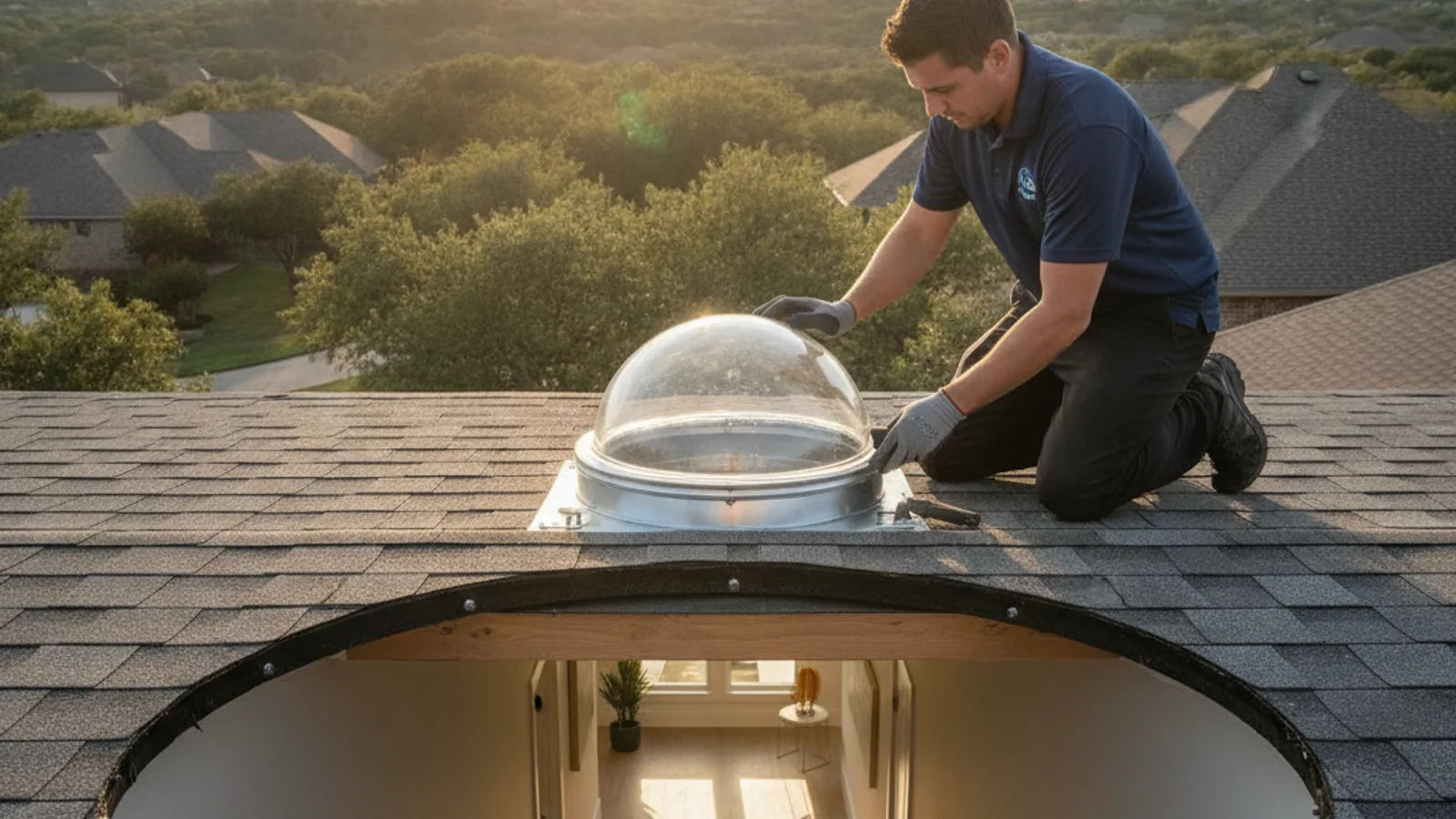
A sun tunnel, also called a solar tube or tubular daylighting device, is a small roof-mounted dome connected by a reflective tube to a ceiling diffuser. It brings real daylight into a room that has no exterior wall to put a window on, which is a category of room that a full skylight simply can’t reach.
A lot of homeowners hear “sun tunnel” for the first time while trying to solve a specific problem, usually a dark hallway, an interior bathroom, or a closet with no light source beyond a bulb, and don’t realize there’s a product built specifically for that. Once you understand what a sun tunnel actually is and how little it disrupts the room around it, it tends to move from a curiosity to an obvious fix pretty quickly.
How it physically works
There are three parts. A clear dome sits on the roof and collects daylight from whatever angle the sun happens to be at throughout the day. A reflective metal tube runs from that dome down through the attic, bouncing light along its length with very little loss over a short run; the interior surface is engineered specifically to reflect as much of that light as possible rather than absorb it. A diffuser panel sits flush in the ceiling below, spreading that light evenly into the room rather than throwing a single hot spot of sunlight onto the floor.
The whole system has no moving parts and nothing to maintain in the way a mechanical fixture would. It’s essentially a very efficient light pipe, redirecting daylight that’s already hitting your roof into a room that otherwise never sees it.
What it looks like from inside
The light is diffuse and even, closer to daylight than a lamp. It’s common for a first-time visitor to a room with a sun tunnel to assume there’s an electric fixture left on, until they notice it dims and brightens with the actual weather outside, or notice there’s no visible bulb behind the diffuser at all. On a bright, clear day the light can be strong enough to read comfortably by. On an overcast day it dims considerably, since a tube depends on redirected daylight rather than a direct electric source, which is worth knowing before assuming it will perform exactly the same every day of the year.
Where it fits best
Hallways, closets, laundry rooms, and interior bathrooms are the classic uses, since these are rooms that often have no exterior wall at all, and adding one via a full remodel would mean cutting into framing that doesn’t exist along an outside wall to begin with. A small, windowless kitchen is another strong fit, and we cover that specific case in more depth in a separate post about brightening a dark kitchen without adding windows. In general, any room where a full skylight isn’t structurally possible, or would be disproportionately expensive relative to the room’s size, is worth evaluating for a sun tunnel instead.
What it is not
A sun tunnel is not a skylight. You don’t get a view of the sky, and most models don’t open for ventilation the way a vented skylight can; it’s a fixed daylighting device, not a window substitute. It’s also not a solar panel. It doesn’t generate electricity or power anything in your home; it simply redirects daylight that’s already there, the same way a mirror redirects light without creating any of its own. The name overlap with “solar” causes real confusion, and clearing that up is most of what this post is for. If you’re picturing something with electrical output or battery storage, that’s a different product entirely.
Why Austin homes are a strong fit
Austin gets roughly 2,665 hours of annual sunshine, working out to about 115 mainly clear days a year, which is a solid amount of raw daylight for a tube to redirect. On top of that, a lot of Central Austin’s mid-century housing stock in neighborhoods like Allandale, Crestview, Brentwood, and Windsor Park is single-story with genuinely accessible attics, which is close to the ideal install scenario for a sun tunnel. A short, unobstructed run from roof to ceiling means less light loss along the way and a faster install, and single-story homes in this part of the metro tend to offer exactly that.
Typical install disruption
Because there’s no drywall to reframe and no window opening to cut, a straightforward attic run is usually finished in a matter of hours, not days. The roof penetration, the tube run through the attic, and the ceiling diffuser cutout are the main steps, and a single-story home with clear attic access is close to a best-case scenario for how fast this goes. Compare that to what a full skylight install typically involves, cutting through both roof and ceiling framing and often coordinating drywall repair, and it’s easy to see why a sun tunnel is the faster, less invasive option for the rooms it’s suited to.
Comparing the experience to a regular electric fixture
The most common thing people notice after living with a sun tunnel for a while is how much the light shifts through the day, brighter around midday, softer in early morning and late afternoon, dimmer under cloud cover, in a way a fixed electric light never does. Some homeowners find that variability is exactly the appeal, since it makes an interior room feel more connected to the actual time of day outside rather than lit the same flat way regardless of the hour. Others add the electric light kit specifically because they want a consistent light level available on demand regardless of outdoor conditions, which is why that add-on option exists in the first place.
What determines how bright a specific installation ends up
Not every sun tunnel performs identically, even within the same product line. Tube diameter is the biggest factor, a 14-inch tube carries meaningfully more light than a 10-inch one over the same run length. Run length and the number of bends in the tube matter too; a short, straight shot from a roof directly above the room loses very little light along the way, while a longer run with an angled bend to route around an obstruction loses somewhat more. Roof orientation plays a role as well, since a dome facing generally south or catching more direct sun through the day collects more light than one on a shaded north-facing roof plane under heavy tree cover. None of this means a longer or angled run isn’t worth doing, it usually still outperforms no daylight at all by a wide margin, but it’s useful context when comparing a quote for a straightforward install against one for a more complex attic run.
How it compares to simply adding a bigger bulb or more fixtures
Some homeowners consider just swapping in a brighter bulb or adding a second overhead fixture before learning about sun tunnels, and it’s worth explaining why that’s a different kind of fix. More wattage changes how bright a room is, but it doesn’t change the quality of light the way daylight does, and it does nothing for the electric bill since it’s still power being consumed to produce that light. A sun tunnel adds genuinely free daylight during the hours the sun is up, and most homeowners who’ve compared the two describe the tube’s light as visually different in a way that’s hard to replicate with a brighter bulb alone.
Is a sun tunnel the same as a solar tube?
Yes. Sun tunnel, solar tube, and tubular daylighting device all refer to the same product category; the naming just varies by manufacturer and by who’s talking about it. You won’t find a meaningful functional difference between a product marketed under one name versus another.
Does a sun tunnel need electricity?
No. The daylight tube itself needs no wiring or power source. Some models offer an optional add-on electric light kit for nighttime use, so the same fixture provides light after dark, but that’s a separate add-on component from the core daylighting function, which we cover in more detail elsewhere.
Do sun tunnels work in a two-story house?
They can, though a longer run from the roof down through a second story and into the ceiling below means a somewhat longer tube and a slightly more involved install than a single-story attic run. Some light loss is expected over a longer run, though modern reflective tube materials keep that loss fairly modest for most typical two-story installs.
If you’ve got a dark hallway, closet, or interior bathroom that never sees daylight, a sun tunnel is worth a look before you assume nothing can be done about it. Bright Sky ATX connects Austin homeowners with experienced, insured local crews for sun tunnel installation and solar tube installation. Call (737) 477-8898 for a free estimate.