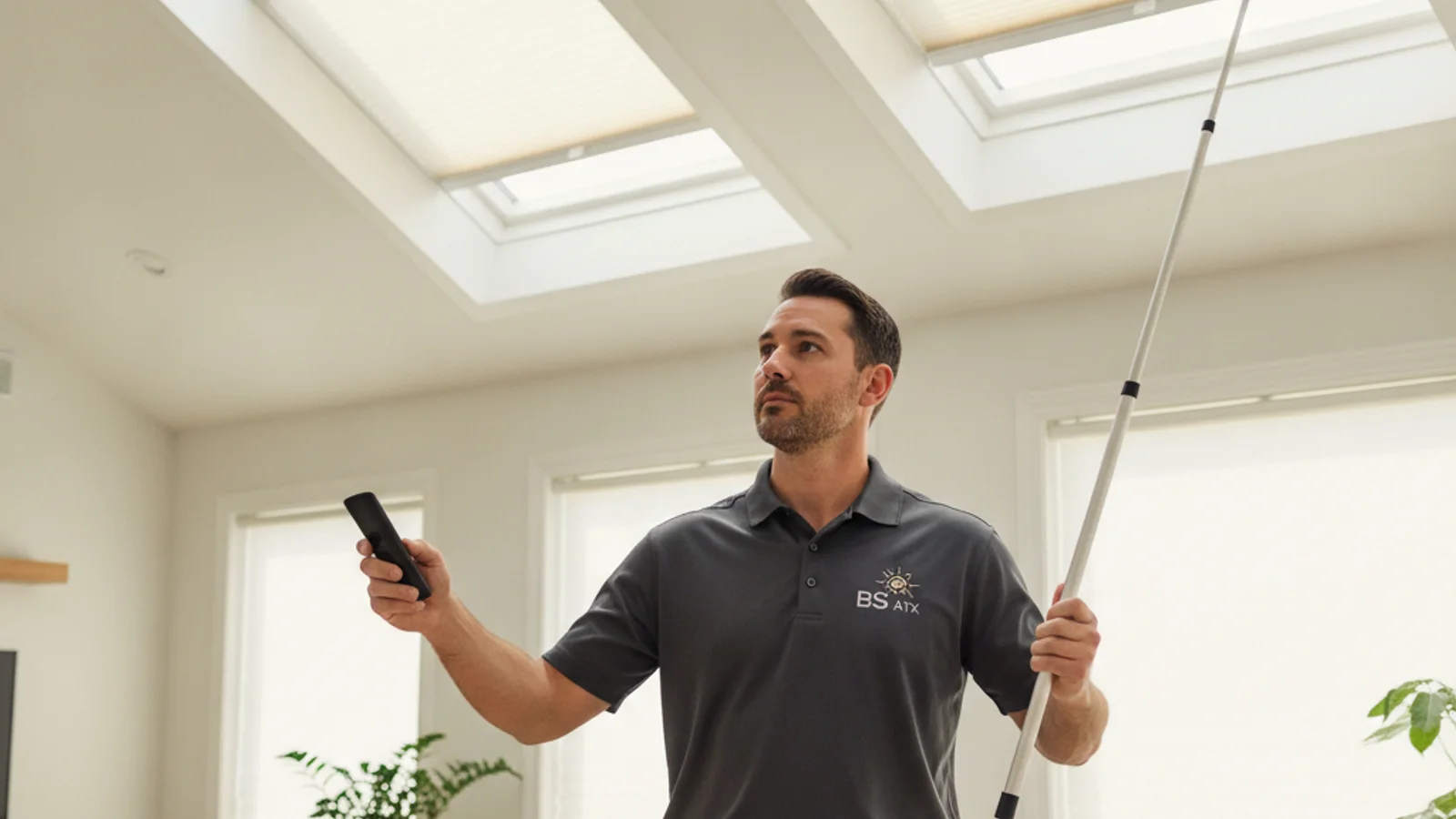
Skylight blinds and shades both block glare and heat. The real difference between the two options homeowners weigh is the control method, manual pole or crank versus motorized remote or app, not the fabric itself. Once you know that, the decision becomes less about which product is “better” and more about which control method fits how the skylight is actually used day to day.
A lot of the confusion between “blinds” and “shades” for skylights comes from how those same words get used loosely for regular windows, where the distinction is usually about slats versus fabric. For a skylight, most products on the market are fabric-based regardless of what they’re called, so the meaningful comparison shifts to how you operate them.
Why this matters more in Austin than in a milder climate
Direct summer sun coming straight down through an unshaded skylight adds real heat gain to a room, even with a code-compliant, low-SHGC glazing already installed. Residential skylight SHGC in Austin’s Climate Zone 2 code tops out at 0.28, with a narrow exclusion up to 0.30, which means even a fully compliant unit still lets some solar heat through. Shades and blinds are a genuine supplemental control on top of that, not a substitute for it, and in a room that gets direct overhead sun for a large part of the day, that supplemental control makes a noticeable difference in comfort even when the AC is working fine.
Manual vs. motorized, compared
| Factor | Manual | Motorized |
|---|---|---|
| Upfront cost | Lower | Higher |
| Retrofit onto an existing skylight | Usually straightforward | Depends on wiring access |
| Daily convenience | Pole or crank each time | Remote or app control |
| Best for | Reachable, lower-slope skylights | High or hard-to-reach skylights |
A skylight mounted low on a shallow-pitch roof is often fine with a manual pole system, since reaching it with a telescoping pole isn’t a hassle. A skylight up in a vaulted ceiling, well out of reach, is where motorized control earns its cost difference; nobody wants to be fetching a tall pole and stretching to reach a shade twenty feet up every time the sun angle changes through the day.
Fabric and opacity options, in plain terms
Blackout fabric blocks light almost entirely, useful for a bedroom skylight where you want full dark for sleep, particularly relevant for anyone with an early alarm or a schedule that doesn’t match sunrise. Light-filtering fabric softens direct sun while still letting daylight through, which suits a living room or kitchen where you want the room to stay bright without a harsh direct beam moving across the floor throughout the day. Solar screen fabric cuts glare and heat while keeping some visibility toward the sky, a middle option worth considering for a room used during the day where you still want some connection to the outdoors.
Which skylights can retrofit shades, honestly
Newer skylights are usually built with shade tracks already accounted for in the frame design, so adding blinds or shades later is often a clean retrofit that doesn’t touch the skylight unit itself. Older units sometimes weren’t designed with that in mind, and adding shades can require a frame or trim modification rather than a simple bolt-on, which adds cost and time beyond just the shade purchase itself. It’s worth having this checked before assuming a retrofit will be simple, especially on a skylight that’s more than a decade or two old.
The bedroom case specifically
Blackout shades over a bedroom skylight are one of the most common specific requests we hear, usually from someone who loves the daylight during the day but wants real darkness at night, or who’s dealing with an early summer sunrise flooding the room well before their alarm goes off. Motorized blackout shades solve this well for a skylight that’s out of easy reach, since you’re not climbing or reaching for a pole every night and morning, and a scheduled or remote-controlled close means the room is dark exactly when you want it without having to remember to do anything manually.
For the pricing-specific version of this question, we cover typical cost ranges for Austin installs separately.
Smart home and app integration
Motorized shades increasingly come with app-based control, and some integrate with broader smart home systems for scheduling based on time of day or sun position rather than requiring manual operation every time. For a bedroom skylight, a scheduled close before sunrise handles the blackout question without anyone remembering to do it. For a kitchen or living room, a schedule that opens shades in the morning and closes them during the hottest part of a summer afternoon can help manage heat gain automatically. This kind of automation is an added cost on top of the base motorized hardware, so it’s worth asking specifically whether a quoted motorized system includes scheduling capability or just remote-only operation.
How placement and roof pitch affect the choice
A skylight’s angle on the roof changes how a shade behaves once it’s closed. On a steeply pitched roof, a shade sits closer to vertical and gravity helps keep it in place with less mechanism needed to hold position, similar to a regular window shade. On a low-slope or nearly flat skylight, a shade sits closer to horizontal, which puts more stress on the tracking hardware to hold the fabric in place against its own weight, and it’s part of why some manufacturers spec heavier-duty tracks specifically for low-pitch applications. It’s worth asking whether the shade system being quoted is rated for your specific skylight’s pitch rather than assuming one product fits every roof angle equally well.
Installing shades at the same time as a new skylight vs. retrofitting later
If you’re already planning a new skylight installation, it’s worth deciding on shades at the same time rather than as an afterthought. Installing the shade track during the initial install is typically simpler and less expensive than coming back later to retrofit one onto a finished skylight, since the frame and trim work can be planned together from the start. If you’re not ready to commit to motorized versus manual yet, at minimum ask your installer whether the frame they’re using supports adding either option later without extra modification, so you’re not locked out of a choice down the road.
Maintenance and longevity
Fabric shades for skylights hold up well over time with basic care, mainly keeping them clean of dust, which accumulates differently than it does on a vertical window shade since a skylight shade sits horizontally or near-horizontally and collects more settled dust on its upper surface. Motorized components add a mechanical element that, like any motor, has a working life, though quality units are built for years of regular use. Ask about the warranty on motorized components specifically, separate from the fabric warranty, since those two parts of the product often carry different coverage terms.
Do skylight blinds actually reduce heat?
Yes, meaningfully. They block direct solar gain from reaching the room, working alongside the skylight’s own glazing rather than replacing what the glazing already does, and the combined effect of code-compliant glass plus a shade is noticeably more comfortable than glass alone in a room that gets a lot of direct overhead sun.
Can shades be added to an existing skylight?
In most cases, yes, though older units without a built-in shade track sometimes need a frame or trim adjustment first. It’s worth confirming before assuming a simple retrofit, since the added labor for a frame modification changes the overall cost of the project.
Are motorized shades worth the extra cost?
For a skylight that’s genuinely hard to reach, most homeowners find the daily convenience worth it, particularly once they’ve lived with the alternative of ignoring the shade because reaching it is a hassle. For a low, easily reachable skylight, manual control does the same job for less money, and there’s no real functional downside to going manual in that situation.
If you’re weighing blinds against shades for a specific skylight in your home, it’s easier to decide once someone’s actually looked at the unit and its placement. Bright Sky ATX connects Austin homeowners with experienced, insured local crews for skylight blinds and shades and skylight installation. Call (737) 477-8898 for a free estimate.