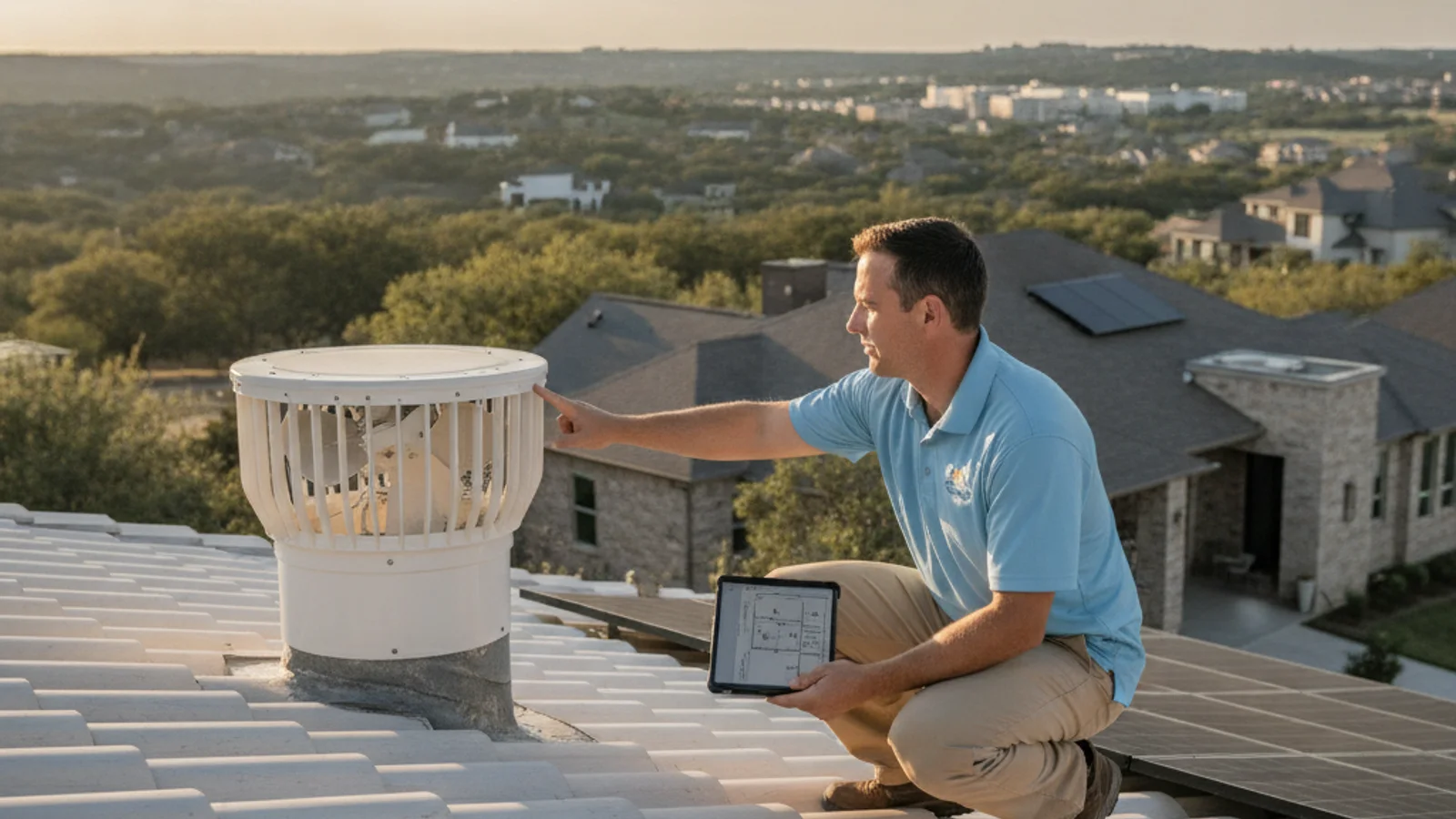
An attic fan needs to be sized to the attic’s square footage and roof pitch, not picked because it was the cheapest option at the store. An undersized fan on a large attic runs all day and barely changes the temperature. Getting the size right is the difference between a fan that actually does its job and one that’s just spinning for show.
The basic sizing logic, in plain terms
Two numbers drive the calculation: the attic’s square footage and the roof’s pitch. Manufacturers publish sizing charts that translate those two numbers into a target airflow rating, measured in CFM, or cubic feet of air moved per minute. A bigger attic needs more CFM to fully exchange the air inside it in a reasonable amount of time. A steeper roof pitch also adds attic volume for the same footprint, which pushes the CFM target up too.
This is why a fan that worked fine on a neighbor’s ranch-style home might be badly undersized for a steeper Hill Country roofline with more attic volume behind the same square footage of ceiling below.
Why Austin attics need this done right
Attics across the metro commonly reach 120 to 150 degrees at peak summer, as much as 50 degrees above the outdoor air temperature. That’s the load a correctly sized fan is working against. A fan that’s too small for the space keeps cycling without ever pulling that heat load down meaningfully, which means the AC below keeps working just as hard as it would with no fan at all.
When one fan isn’t enough
Large or complex rooflines, especially ones with multiple hips, valleys, or separated attic sections, sometimes need more than one fan to move air effectively across the whole space. Two smaller fans placed on different roof planes can outperform a single larger unit that’s stuck trying to pull air from a section of the attic it isn’t positioned to reach. This comes down to layout as much as raw CFM, which is a reason a real attic walkthrough beats guessing from square footage alone.
Panel size and fan capacity are linked
On a solar-powered unit, the panel has to be sized to the fan, not just bolted on for looks. A bigger fan motor draws more power to run at full capacity, and an undersized panel means the fan never reaches its rated CFM even on a sunny day. This is one of the places a bargain solar attic fan kit falls short: matched panel-to-motor sizing from the manufacturer tends to perform more reliably than a mismatched aftermarket pairing.
Existing ventilation has to support the fan
A fan pulls hot air out, but it needs somewhere for replacement air to come in. Soffit vents and any existing ridge venting have to be open and adequate, or the fan ends up straining against a space that can’t feed it enough intake air. The same honesty that applies to whether an attic fan is worth installing at all applies here: insulation and air sealing, and confirming intake venting is adequate, come before fan sizing solves anything on their own.
Common sizing mistakes
The two mistakes that show up most: mounting a fan on a roof slope with the wrong sun exposure for a solar unit to run at capacity, and undersizing the fan to save money upfront. Both lead to the same outcome, a fan that technically runs but never delivers the cooling effect it was bought to provide.
How many CFM does a typical Austin attic need?
It depends on the attic’s specific square footage and pitch, which is why manufacturer sizing charts and a real measurement matter more than a rule-of-thumb number pulled from a different climate or a different roof shape.
Does roof pitch affect fan sizing?
Yes. A steeper pitch adds attic volume for the same footprint below, which pushes the target CFM higher even if two homes have the same square footage of living space underneath.
Can an attic have too much fan capacity?
Oversizing is rarely the problem homeowners run into, but a fan that’s dramatically larger than the space needs adds cost without a proportional benefit, and multiple correctly sized fans usually beat one oversized unit on a complex roofline anyway.
Getting it sized right the first time
Bright Sky ATX connects Austin homeowners with experienced, insured local crews who measure the attic and roof before recommending a fan size, not after. Call (737) 477-8898 for a free estimate on solar attic fan installation or a whole house fan as a complementary option.