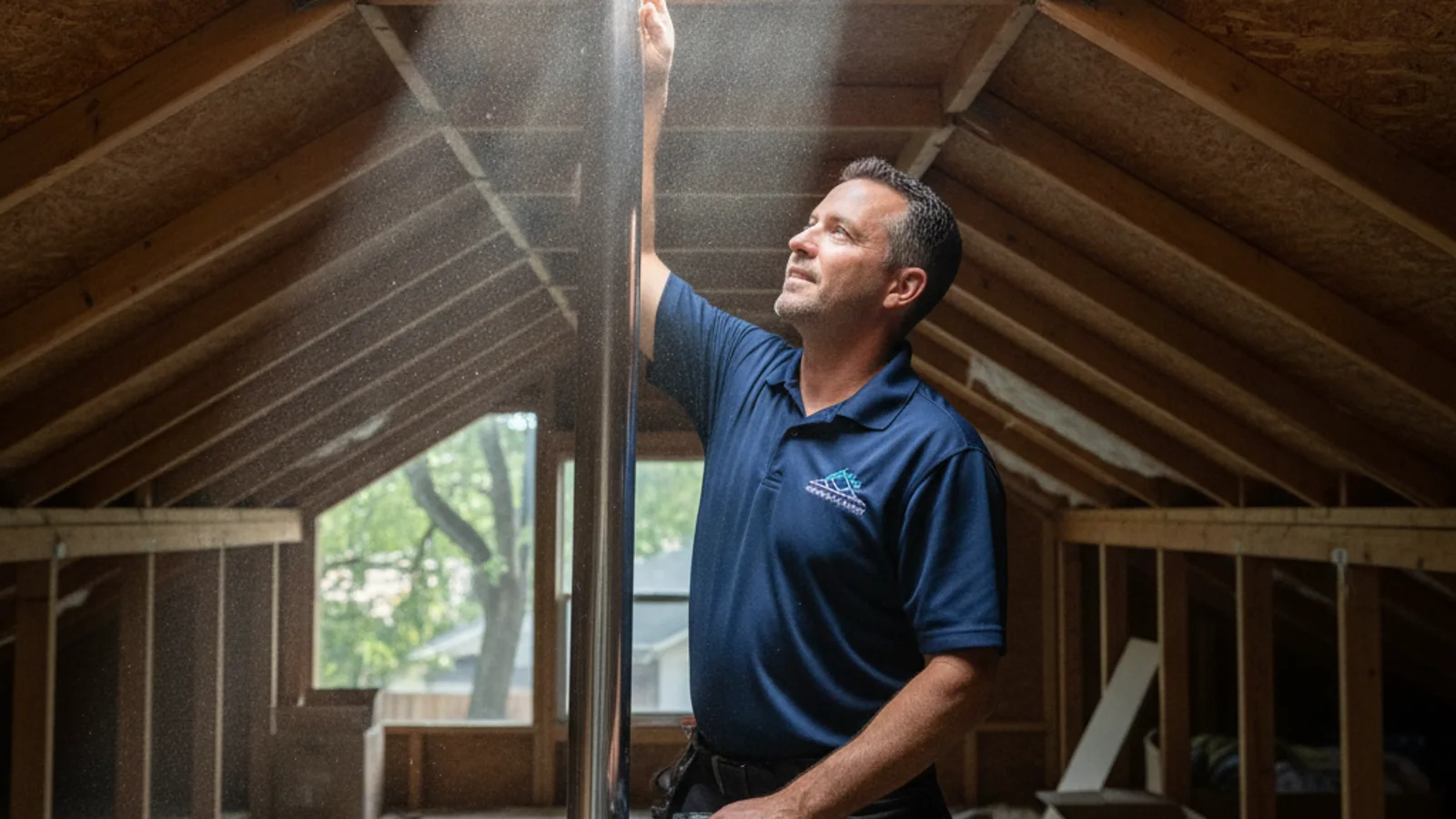
Hyde Park and Allandale bungalows are close to ideal solar tube territory. Both neighborhoods have large, often underutilized attic space and low-pitched roofs, which make a short, straightforward tube run possible in most rooms. If you own one of these homes and you’ve got a dark hallway or an interior kitchen, the physical conditions overhead are already working in your favor.
What makes this housing stock different from a newer suburb
Hyde Park is predominantly 1 to 1.5-story Craftsman bungalows, typically 1,000 to 1,800 square feet, with low-pitched gabled roofs and wide eaves. Allandale runs mid-century modern, with flat or low-sloped rooflines, large lots, and mature tree cover. Both share the same underlying feature that matters for this project: generous original attic volume that a lot of newer, tighter-built suburban homes simply don’t have.
That extra attic volume translates directly into an easier install. A short, direct run from roof to ceiling loses less light and takes less labor time than a tube that has to snake around framing obstructions in a tighter attic.
Where the light problem tends to be worst in this stock
Center-of-plan kitchens and hallways, positioned away from the home’s original window layout, are the rooms that show up most often in these neighborhoods needing a daylight fix. Brightening a dark kitchen without windows covers that exact scenario in more depth, and it’s a pattern that repeats block after block in this part of Central Austin.
The Hyde Park wrinkle: historic-district review
Hyde Park is a National Register Historic District, designated in 1990, which means visible roof modifications need a Certificate of Appropriateness before work starts. That said, a rear-facing, low-visibility solar tube installation is often a considerably more straightforward case for that review than a large, front-facing skylight would be, since the review focuses on street-visible changes. Skylights in Austin’s historic districts walks through how that process works in full.
Allandale and Crestview, by contrast
Neither Allandale nor neighboring Crestview carries a historic-district layer, so a solar tube project there goes through the standard city permitting process without the extra Certificate of Appropriateness step. Skylight permit Austin covers what that standard process involves.
What an install actually looks like in this stock
In a typical Hyde Park or Allandale bungalow, the run is short: roof penetration, a direct or lightly angled tube through generous attic volume, and a ceiling diffuser, usually completed in hours rather than a full day. There’s no reframing involved, and disruption to the room below is minimal since the work happens almost entirely from the attic and roof side.
Does a Hyde Park bungalow need historic approval for a solar tube specifically?
Yes, since Hyde Park’s historic-district status applies to any exterior roof modification, solar tubes included. In practice, a rear-facing tube on a non-street-visible roof plane tends to move through that review more easily than a larger, more visible change.
Is Allandale’s attic access typically easier than newer construction?
Generally yes. Allandale’s mid-century, low-slope homes tend to offer more open attic volume and simpler access than a tightly framed newer build, which usually means a faster, less complicated install.
How many tubes does a typical bungalow kitchen need?
It depends on the kitchen’s size and layout, but a single tube is often enough for a smaller galley-style kitchen, while a larger open kitchen may benefit from two placed over different work areas.
Getting your attic assessed
Bright Sky ATX connects Hyde Park and Allandale homeowners with experienced, insured local crews for solar tube installation and sun tunnel installation. Call (737) 477-8898 for a free estimate.