An Austin kitchen can stay dim at noon when the cooktop sits under a hall, a second story, or a long ranch roof. A sun tunnel can light that room on its own in some houses. In others the kitchen still needs a skylight, a second tube, or both.
How much light a kitchen actually needs
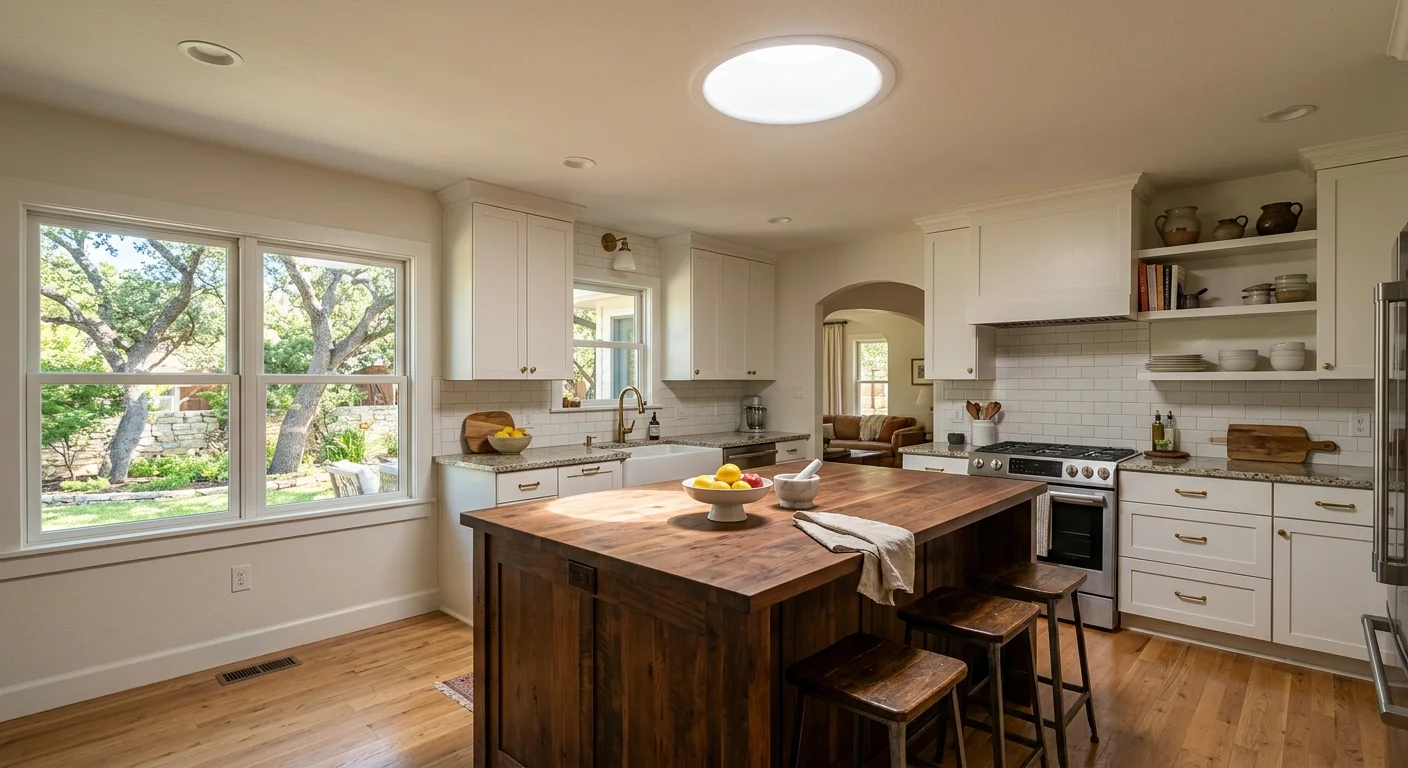
A kitchen has to do more than look bright from the doorway. You chop on a board, read a label, and judge color on a cooktop. Those tasks need a steady wash on the work plane, not a bright spot on the floor. A sun tunnel kitchen light that looks fine in a photo can still leave the sink in shadow if the diffuser sits over the wrong stretch of ceiling.
There is no single kitchen-light number on this page, and that is on purpose. A published lumen, foot-candle, or tube-diameter rating for Austin kitchens could not be confirmed in Bright Sky ATX’s claims ledger. The figure that matters is the one on the product spec for the unit the contractor proposes, checked against the actual room. Ask to see that sheet. Then have the pro stand in the kitchen at midday and again later, because Central Texas light shifts hard from morning to late afternoon.
Austin kitchens are not one shape. A galley in a Hyde Park or Clarksville bungalow is a narrow work slot with a hall between the windows and the stove. A 1960s ranch in Allandale or Crestview often puts the kitchen in the middle of a deep plate, with living rooms taking the street glass. Newer two-stories in Round Rock, Cedar Park, Pflugerville, Kyle, and Buda push the kitchen even farther from the roof. East Austin and the urban core add tree shade from live oaks. West of town, Bee Cave, Lakeway, and Dripping Springs add taller attics and more metal roof.
What the room already has matters as much as what you add. A kitchen with a glass door to a south patio is not starting from the same place as an interior kitchen that only sees light from a hall. An open plan that runs into a dining end needs a wider wash than a tight galley. If you only light the island, the perimeter counters still feel like a cave. The honest test is whether the surfaces you actually use are readable without flipping a switch at noon.
When a sun tunnel is enough on its own
A sun tunnel is enough on its own when the kitchen is small, the roof is close, and the tube can run short and straight. That is common in one-story ranches where the kitchen ceiling is the attic floor. The collector sits on the roof almost over the sink or the island. The diffuser lands on the work zone, not in a hallway. In that layout, one well-placed tube can carry daytime tasks without a second opening.
Galley kitchens and interior rooms are the usual win. If the only darkness is a cook line boxed in by a hall, a tube can punch daylight through the attic and stop the cave feeling. Homeowners also ask can a solar tube light a kitchen in the same breath, because solar tube and sun tunnel are the two names people use for this kind of roof-to-ceiling pipe. The question is the same: will the diffuser cover the work, or will you still reach for a switch.
Short path, clear sky, and a modest room. Those three together are the green light. A south or east roof with a clean view of the sky helps. A north roof under a neighbor’s second story, or under a heavy oak canopy in central Austin, gives you less to work with. A kitchen that already has a window on one wall may only need the tube to fix the dark corner. That is a different job than lighting a windowless interior kitchen from zero.
Keep this distinct from a whole-house daylighting plan. One tube is not a skylight substitute for a big open kitchen. It is a targeted lamp that runs on the sun. If your goal is to brighten a dark kitchen without adding wiring, a tube is often the first thing to price with a pro, because it does not need a new electrical run for daytime use. Night is a separate question. A tube without a light kit goes dark when the sky does.
Sun tunnel installation still has to fit the attic. Ducts, trusses, and a second-floor chase can turn a “simple” kitchen tube into a long, bent run. When that happens, skip ahead. Length and elbows are how a unit that looks right on a brochure underperforms over a real Austin cooktop.
When an Austin kitchen still needs a skylight
Some kitchens want a view of sky, not a round diffuser. If the room is the social center of the house, a tube can look like a spotlight on a ceiling that wants a broader wash. Deep open plans in the north corridor and in Hays County two-stories often stretch from a street-facing living room to a rear kitchen. One disc over the island will not carry that whole volume. A skylight, or a skylight plus a tube over a dark pantry run, is the more honest layout.
Kitchens under a second floor are the other hard case. The tube has to travel through a chase, past joists, and often around HVAC. Every bend costs light. You can still use a tube there, and many Austin houses do. It may not be enough on its own for chopping and cleanup. Pairing it with a skylight in a roof that actually sits over part of the kitchen, or adding a second tube at the far counter, is a common on-site call.
Heat is part of the kitchen question in Climate Zone 2. A large skylight brings more sky, and more solar gain, than a small tube. City of Austin residential energy code publishes skylight maxima of U-factor 0.60 and SHGC 0.28 for that climate zone. A matching, published kitchen-output rating for sun tunnels could not be confirmed here, so do not treat those code numbers as a tube spec. For the skylight side of the comparison, ENERGY STAR’s windows, doors, and skylights criteria are the consumer-facing place to start, and the U.S. Department of Energy’s heating and cooling guidance is the plain-language backdrop for why a big pane over a west kitchen can fight the AC on a long Austin afternoon.
If you want a side-by-side of how the two openings throw light, read the skylight vs. sun tunnel light-output guide. This page stays on the kitchen decision. Choose a skylight when you need area, a view, or a vented unit. Choose a tube when you need a small roof cut over a dark work zone. Choose both when the island is under a second story and the dining end has roof above it.
Hill Country metal roofs and tall attics change the math again. The kitchen may be a long vertical distance from the collector. That is still a tube job if the room is small. It is a skylight job if you are trying to light a wide great-room kitchen from one opening.
How tube length and roof position change output
Output falls as the tube gets longer and as the run picks up elbows. A collector almost over the kitchen, with a straight drop through a shallow ranch attic, is the best case in Travis County stock. A collector on a far roof plane, snaked around a trunk line, then dropped through a two-story chase, is the worst case in the same metro. The product is similar. The path is not.
Roof position is the other half. A collector that sees open sky will outperform one parked in the shade of a live oak, a neighboring two-story, or a ridge. South and east planes tend to deliver more usable kitchen light through the middle of the day. A north plane can still work. It will not behave like a south plane on the same house. West collectors can feel strong in late day and weak at breakfast, which matters if your dark hour is the school-morning rush.
Trees are a local factor, not a footnote. Central Austin, Hyde Park, Travis Heights, and older East Austin lots often have canopy that a new-build lot in a Williamson County subdivision does not. The same tube, on the same roof pitch, will not read the same under a mature oak as it will on a bare ridge in Circle C or a new street in Kyle. Have the pro look at winter and summer shade. Leaves drop. Neighboring second stories do not.
Do not trust a brochure lumen number that is not on the spec in your hand. Bright Sky ATX could not confirm a publishable output rating, diameter chart, or foot-candle target for kitchen tubes. The contractor should pull the manufacturer’s sheet for the exact unit, then walk the attic with a light in hand and show you the run. If the run needs two hard bends to miss a truss, ask what that does to the result in this kitchen, not in a catalog photo.
Elbows, length, shade, and ceiling placement stack. Fix one and ignore the others, and the island still sits in a dull circle. Place the diffuser over the work you care about. A beautiful disc over the walking path between the fridge and the hall is wasted kitchen light.
What an independent installer should check
The pro you are matched with should start in the kitchen, not on the roof. Mark where you stand to cook, clean, and plate food. Then go into the attic, if the house has one, and find a clean path from a roof plane with sky to that mark. If the path is ugly, the honest move is a different roof location, a second tube, or a skylight on a plane that actually sits over the room.
Roof type is next. Composition shingle is common across much of Travis County. Standing-seam metal shows up more as you move west into the Hill Country. Flashing details change with the roof, and a kitchen tube is still a roof penetration. The check is whether the unit and the flashing match that roof, not whether a generic kit “should be fine.” Hail history in this metro is real, including the September 24, 2023 Central Texas storm that NWS and NCEI treated as the costliest Austin-area hail event on record. A kitchen tube does not change that weather. It does mean the collector and flashing have to be detailed like any other roof opening.
Inside, look at ducts, trusses, recessed cans, and the second-floor stack if there is one. A kitchen under a hall bath is a different chase than a kitchen under an open attic. Ask where the diffuser will land relative to the island, the sink, and the range. Ask whether two shorter tubes would beat one long one. Ask what the unit does at night, and whether a light kit is even on the table. Daytime output is this page’s question. Night is extra, and it is electrical work on top of the roof work.
The pros in the Bright Sky ATX network are experienced and insured independent contractors. You contract with the pro directly. Have that person show you the product spec, the roof plane, and the attic path before anyone cuts a hole. If a number is not on that spec, treat it as unconfirmed. A kitchen you cannot work in at noon is the failure mode. The visit is how you avoid it.
When to call us
Roof cuts, flashing, and a tube run through an Austin attic are contractor work, especially over a kitchen you use every day. If you are weighing a sun tunnel against a skylight, or you cannot tell whether one opening will cover the cook line, that is the moment to bring in a skylight and daylighting pro. Call us at (737) 477-8898 and we will match you with an experienced, insured local pro.