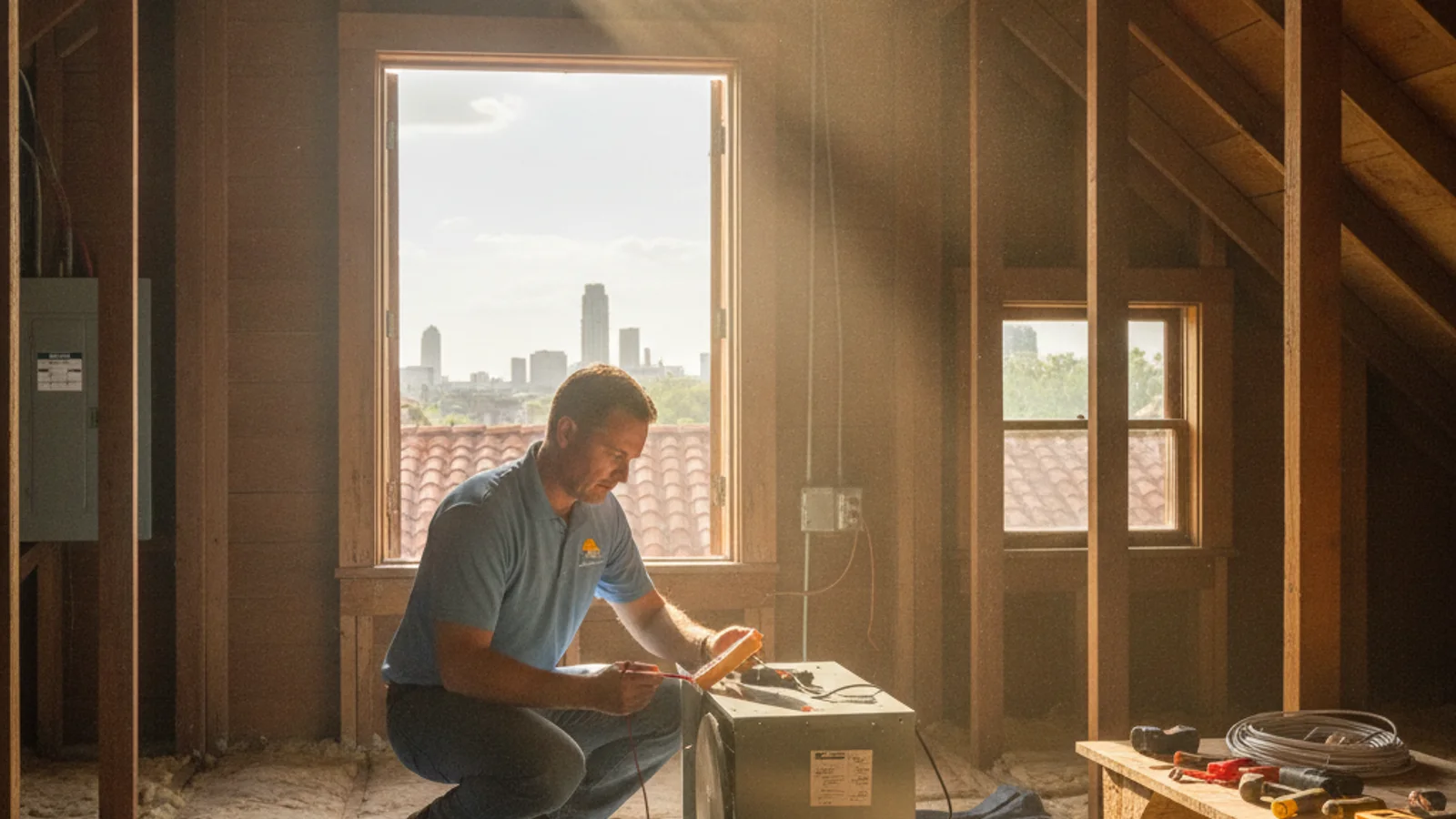
An older home can usually be fitted for a whole house fan, but the attic clearance, existing wiring, and ceiling structure need a real assessment first, not an assumption based on the home’s age alone. Some older homes are easier candidates than newer ones. It depends on specifics, not the decade the house was built.
What “wired for it” actually means
Most whole house fans need a dedicated electrical run to the fixture’s location, and this is where older homes most often run into a real obstacle. A home with its original panel, or one that still has remnants of knob-and-tube-era wiring, sometimes can’t support a new dedicated circuit without an electrical panel upgrade first. This isn’t a reason to rule out the project. It’s a reason to have an electrician check the panel’s capacity before assuming the wiring side will be simple.
Attic clearance and structure
A whole house fan needs enough open attic volume to exhaust the air it pulls up from the living space, and it needs ceiling joists capable of supporting the fan’s mounting weight. Attics in older homes vary widely here. Some have generous, mostly open volume that’s ideal for this kind of install. Others have been partially finished, insulated in a way that restricts airflow, or framed with joists that need reinforcement before a fan can be safely mounted.
Where this comes up most in the metro
Hyde Park and Travis Heights bungalows, along with Allandale and Crestview mid-century ranches, are where this question comes up most often across Austin. These neighborhoods carry a lot of older housing stock with real attic space and layouts that tend to suit a central hallway installation well, which is exactly the kind of home that benefits most from a whole house fan installation once the wiring and structural questions are answered.
Ceiling access point placement
A central hallway is the typical placement for a whole house fan’s ceiling grille, and there’s a practical reason for it: pulling air from a central point draws it evenly from bedrooms and living areas on either side, rather than concentrating airflow from just one part of the house. Getting this placement right matters more than most homeowners expect, since a fan mounted off to one side of the house tends to pull unevenly and leave some rooms barely cooled while others get more airflow than needed.
Cost reality when electrical upgrade work is involved
When a panel upgrade or new dedicated circuit is needed alongside the fan itself, the total project cost goes up meaningfully compared to a straightforward install on a home with adequate existing wiring. It’s worth getting the electrical assessment done as a first step, separate from the fan quote itself, so there aren’t surprises once the project is underway. Ranges vary enough by home that a firm number really does depend on an on-site look rather than a general estimate.
Weighing it against a solar attic fan
A whole house fan and a solar attic fan solve related but different problems. A whole house fan cools the living space directly by pulling in cooler outside air at night. An attic fan cools the attic itself, which reduces how hard the AC has to work but doesn’t move air through the living space the way a whole house fan does. Some older homes genuinely benefit from having both, particularly ones with hot attics and cool evening temperatures for much of the year.
Can a 1950s Austin home get a whole house fan without rewiring?
Sometimes, if the existing panel has capacity and there’s a reasonably direct path to run wire to the ceiling location. It depends on the home’s specific electrical history, which is why an assessment matters more than the home’s build decade.
Does attic insulation need to change?
Not always, but insulation that’s been laid in a way that blocks airflow around the fan’s exhaust path may need to be adjusted so the fan can move air out of the attic effectively.
Is a whole house fan noisy in an older home with thinner interior doors?
It can be more noticeable than in a newer, better-sealed home, though proper installation and a well-sized unit reduce this. It’s worth asking an installer about noise level for the specific fan model being considered.
Finding out if your home is ready
The only reliable way to know whether an older home is wired and structurally ready for a whole house fan is to have someone look at the panel, the attic, and the ceiling framing directly. Bright Sky ATX connects Austin homeowners with experienced, insured local crews who assess all three before quoting the job. Call (737) 477-8898 for a free estimate.