A crank you can reach from the floor is a different product than a motor you tap from the kitchen. In Travis, Williamson, and Hays County homes, that split is about height, heat, and how often you’ll actually open the sash. Lock the operating style before you lock the model. A later conversion is not always on the table.
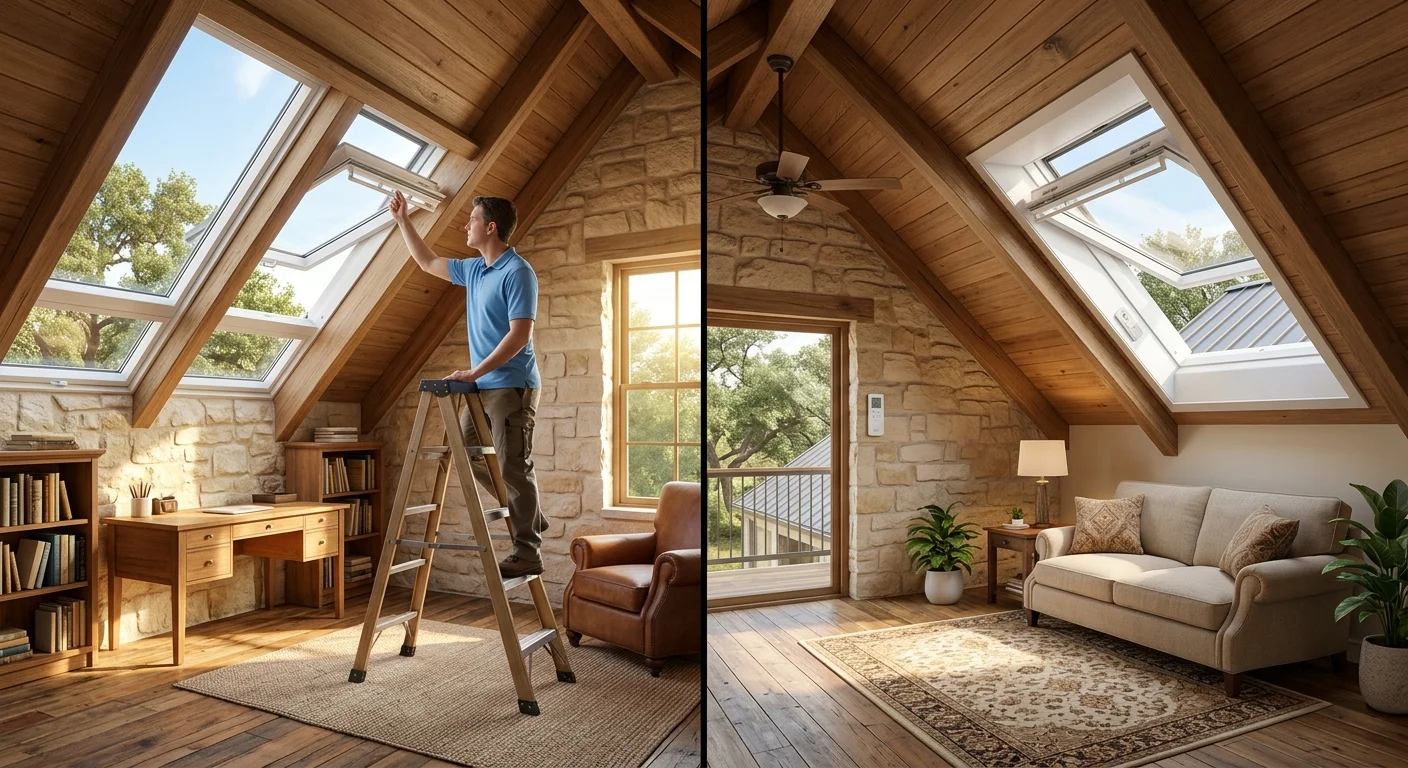
How manual and electric controls differ
Roof windows sit in the roof slope and open. That is the product. A fixed skylight is a different object. If you still need that split, start with our guide to roof windows vs skylights. This page is only about how the sash moves.
Manual vs electric roof windows is a control choice. Glass, flashing, and size still matter. They do not replace the reach test.
A manual unit uses a handle, a winding rod, or a telescoping pole. You stand under it and work the hardware. Center-pivot sashes often rotate so you can clean the outer pane from inside. Top-hung sashes swing out. Neither hinge style is automatically the right buy. Reach is the test.
An electric roof window uses a motor in the frame. You run it from a wall switch, a remote control roof window keypad, or an app if that model offers one. Some motors take house power. Some take a solar pack on the sash. Those are different installs. A solar pack still has electronics. A hardwired unit still needs a legal electrical path.
The effort gap is real. A small sash over a desk in a Hyde Park bungalow is easy to crank. A wide sash over a stair void in a two-story Cedar Park plan is not. Heat makes hardware expand. After a July afternoon on a west slope in South Austin, a stiff crank is common.
Controls also change how often you vent. A switch by the door gets used. A pole in the hall closet does not. That is how people live, not a lab rating.
Maintenance splits the same way. Manual hardware is hinges, gaskets, and a rod. Electric hardware adds a motor, a control, and whatever battery or solar pack that line uses. Confirm the current parts list with the manufacturer. A floor-model sticker is not the ship list.
Compatibility is the quiet trap. Some manual lines have a motor kit. Some do not. Some electric lines share flashings with a manual cousin. Some do not. Ask for the exact model family. Then ask whether that family converts. Bright Sky ATX matches you with independent, insured roof window pros who can read that spec sheet with you. The contractor you hire sets the product. We do not.
Which rooms benefit from remote operation
High sashes are the electric case. Stairwells in two-story Round Rock and Pflugerville plans. Loft bedrooms in East Austin ADUs. A soaking tub under a slope in a Dripping Springs bath. A kitchen unit over an island you will not climb. A home office where you want the sash and the shade from the desk.
A sleeping room is a special case. If that opening is also the emergency exit, operating style is part of the exit plan. A motor that needs power is a different plan than a crank you can work in the dark. Read egress roof windows in Austin before you buy. Confirm the current exit rules with the city or county that has the house. Bright Sky ATX does not interpret code.
Bathrooms want air out after a shower. A remote over a tub is easier than a pole over wet tile. Confirm that the insect screen and any shade still fit that model. Steam does not care about a pretty remote. It cares that the sash actually opens.
Great rooms with tall ceilings look like an obvious electric pick. They often are. A manufacturer-rated rod can still work if you will store it in the room. If the rod lives in the garage, you will not vent. That is the whole decision, dressed up as hardware.
Kids’ rooms and long-term rentals can favor simpler hardware when the sash is in reach. Fewer parts means fewer service visits. Electric still makes sense when nobody can touch the handle. There is no single best roof window. There is a sash you will actually open in August.
Walk the room before you pick. Stand where you cook, sleep, and sit. Note the furniture. Note the stair rail. Note whether a chair would have to live under the unit forever. That walk is worth more than a brochure feature list.
Do not buy electric only because the showroom remote feels convenient. Buy it because you cannot, or will not, work a crank from a safe stance. Manual is the right call when the handle is in your hand from the floor and you will use it.
What rain sensors and screens change
A rain sensor is an add-on on some electric lines. It is not a default on every electric roof window. When it is present and working, it can close the sash as weather hits. Austin pop-up storms make that appealing. It is still a sensor, not a promise. Confirm whether the exact product includes one. Ask how it behaves in a power cut. Ask what the manufacturer says about false closes from irrigation overspray or heavy dew.
Screens change the air story. An insect screen lets you vent without inviting every June mosquito along the Colorado River corridor. Not every sash ships with one. Not every screen is rated for the same opening. Ask, then get the answer in the quote line, not as a verbal maybe.
Interior shades and exterior solar screens are a separate choice. They cut glare and heat gain. They also have to match the operating style. A motorized shade on a manual sash is a mixed system. A manual shade on a high electric sash is a shade you will not close. Pair the shade control with the sash control when you can. Confirm current fit lists with the manufacturer. Lines change.
Cleaning still happens. Pollen, live oak catkins, and caliche dust load the exterior. A center-pivot sash you can rotate from inside is easier to wash. A motor does not clean glass. If you cannot reach the sash, plan for a pro to service it. Do not walk the unit. Roof windows are not a roof deck unless the manufacturer rates that exact product for foot traffic, and most are not.
If you want the science on heat through glass, the U.S. Department of Energy’s heating and cooling primer is a clean starting point. Pair that with the glazing numbers on the unit you are actually buying. A general article cannot stand in for the sticker on your sash.
How heat and roof access affect the choice
Central Texas is not a mild climate. The City of Austin residential energy code uses Climate Zone 2. For skylights, the published maxima are U-factor 0.60 and SHGC 0.28. Confirm with the installer how your roof window is classified on the energy forms. Do not assume a brochure energy badge meets those tables. ENERGY STAR lists current window, door, and skylight criteria. Check the date on that page when you compare glass.
Heat also changes operation. A west-facing sash over a Mueller great room will stack heat under the glass. You may want it closed and shaded at 3 p.m., then cracked after sunset. That daily cycle favors a control you will use. Manual is fine if the handle is in reach. Electric is the practical pick when it is not.
Roof access is the other half. Hyde Park and Allandale bungalows often have lower pitches and shorter runs to the eaves. Hill Country metal roofs in western Travis and northern Hays can be steep, hot, and a long way from a safe ladder point. If the installer cannot reach the unit later, pick a product they can service from inside. Confirm that path with the manufacturer, not from a photo.
Hail is a glass and flashing question more than a motor question. The September 24, 2023 Central Texas hailstorm was the costliest Austin-area hail event on record, with about $600 million in losses across Travis and Williamson counties. Ask what the glass construction is. Ask what the manufacturer warranty covers after impact. Do not treat a motor as storm armor.
Power outages are part of Austin summers. If the sash must close in a storm and the motor needs house power, ask how the model behaves when the grid drops. Some solar packs still run. Some do not. Confirm it. A manual override, if offered, has to be reachable from a safe stance inside the room.
A roof window can still be a good idea in this heat when you can shade it, vent it, and service it. Operating style is how those three things actually happen in your house, not in a catalog.
What to confirm before selecting a model
Write a short list. Take it to the manufacturer page and to the independent installer. Do not skip the unglamorous lines.
Exact model family and size. Whether a motor kit exists for that family. Power path: solar pack, hardwired, or none. Electrical tie-ins in Texas are work for an electrician licensed by TDLR, the state electrical board. Do not treat a hardwired run as optional DIY.
Rain sensor, insect screen, interior shade, and exterior solar screen as separate line items. Each one confirmed in or out. Glazing: U-factor, SHGC, and how the unit will be entered on the City of Austin or other jurisdiction energy forms.
Pitch range, flashing system, and roof material. Standing-seam metal is not the same flashing as composition shingle. Interior reach and any rod or override. Cleaning method from inside.
Manufacturer warranty language for the motor, the glass, and the flashing. Those are the manufacturer’s terms, not ours. Confirm the current text. Do not rely on a screenshot from last year.
If the room sleeps people, whether the opening is part of an egress path. Who pulls any permit the city or county requires. A single statewide roof-window permit rule could not be confirmed for this page. City of Austin, Round Rock, San Marcos, and the counties each run their own desk. Ask the contractor and the building department that has the address. The Texas State Energy Conservation Office publishes statewide energy-program context at the comptroller SECO site.
Then live with the answer for a week. If you will not crank it in August, do not buy the crank. If you will not climb for a shade, do not buy a shade you have to climb for.
When to call us
A new roof window, an electric conversion, or a unit over a space you cannot reach is work for an independent skylight and daylighting pro, not a weekend ladder job. Bright Sky ATX is a referral service. We match you with experienced, insured local contractors, and you contract with them directly. Call us at (737) 477-8898 and we will match you with an experienced, insured local pro.