Picking a fan from square footage alone is how Austin homes end up with a unit that howls, stalls, or sits unused. Whole house fan sizing is a match between living-space volume, attic exhaust, open windows, and the nights Central Texas actually gives you. A model number is the last step, not the first.
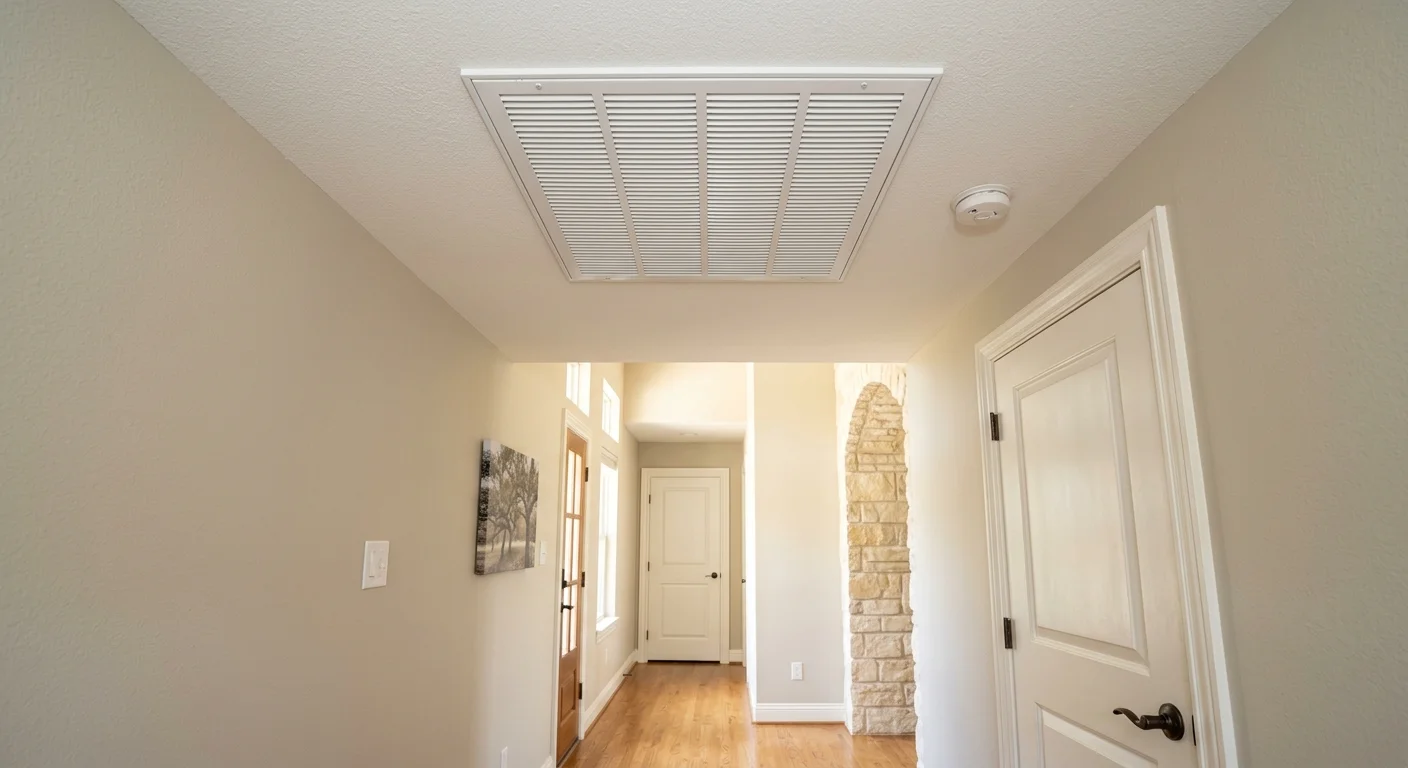
What fan size is trying to accomplish
A whole house fan is not an attic fan. It is not a substitute for air conditioning on a triple-digit Travis County afternoon. It pulls indoor air up into the attic so cooler outdoor air can enter through open windows.
The job is air change, then stored heat. First you dump the hot indoor air. Then you keep a slower flow going so walls, floors, and furnishings give up the heat they soaked up all day. Comfort is both cooler rooms and air moving across your skin.
If the fan is too small, that first dump never finishes before bedtime. Rooms at the far end of a ranch plan stay stale. If the fan is too large for the attic vents, the attic pressurizes. The motor works against itself. You get noise without more useful airflow through the house.
Size is trying to do three things at once. Move the living-space volume on a timetable you will actually use. Stay within what the attic can exhaust. Stay quiet enough that you leave it on.
Manufacturer pages will sell you a calculator. Those tools are not Austin code. They are not a verified local rule we can publish as a number. Treat them as a starting conversation with an independent installer, not a purchase order.
People comparing this equipment to central air should settle the climate fit first. Night ventilation only helps when outdoor air is cooler than the house, and when humidity is something you can live with. That is a different decision from whole house fan vs air conditioning.
City of Austin residential energy code uses Climate Zone 2. That is a heat-driven climate. Sizing homework written for a dry Western night does not automatically transfer to Travis, Williamson, or Hays County. The U.S. Department of Energy heating and cooling overview treats ventilation cooling as one strategy among others. It does not pick a fan for a bungalow in Allandale.
How floor area and airflow shape sizing
Searchers want a CFM for a 2,000 square foot house. Floor area is the first input. It is not the last.
Airflow is measured in cubic feet per minute. Volume is floor area times ceiling height. An 8-foot Hyde Park bungalow and a tall great room in Steiner Ranch are not the same box, even at the same square footage. Bonus rooms, vaulted ceilings, and open stairs all change the volume the fan has to move.
Online formulas multiply square feet by a CFM-per-foot factor. Others chase a target number of air changes per hour. Different brands publish different factors. None of those numeric rules are confirmed as a City of Austin, Travis County, Williamson County, or Hays County requirement. If a page tells you a 2,000 square foot house needs one exact CFM, that figure did not come from a verified local source. We will not invent one here.
What floor area does tell you is direction. More floor usually means more air to move. A long single-story plan in Buda, Kyle, or Cedar Park needs path thinking, not just a bigger motor. Closed bedrooms starve the fan unless windows in those rooms are open. A short-circuit path (one nearby window dumping into a hallway grille) cools the hall and leaves the rest of the house behind.
A 1,200 square foot house does not have a published, confirmed vent count we can quote. “How many vents” is a real question. The honest answer is that net free vent area has to match the fan you install. That match is measured on the roof and in the attic, not guessed from a chart.
Two-story homes often place the grille at the top of the stairwell so both floors can feed the fan. A low, spread-out ranch may need a different location so air does not short-circuit near one hallway. Some plans need more than one intake. That is a layout decision, not a square-footage decision.
Garages, crawl spaces, and other unconditioned spaces should not sit on that air path. You want outdoor air from living-space windows, not air from a parked car or a damp crawl. Floor area that is not on the path does not count the way a simple calculator pretends it does.
Attic-fan questions get mixed into this search. “What size attic fan for a 2,000 sq ft house” is a different machine. An attic fan only moves attic air. A whole house fan moves house air through the attic. If that split is still fuzzy, read attic fan vs whole house fan in Austin before you shop.
Why attic vent area changes the answer
The fan does not dump house air to the outdoors by magic. It dumps into the attic. The attic has to dump to the sky.
If soffits, ridge vents, gable vents, or roof vents cannot pass the air the fan is trying to move, attic pressure rises. The fan works harder. Noise goes up. Airflow through the living space drops. In a bad setup, the unit pulls from the wrong places, including leaks you do not want.
Net free area is the actual open path through a vent, not the hole in the shingles. Screens, baffles, and weather covers reduce that path. Two homes with the same number of vents can have very different capacity. Blocked soffits are not free area. Neither is a ridge vent buried in blown-in insulation.
No ratio of vent area to CFM is logged as a verified Austin rule we can publish. Manufacturer instructions exist. Local code may add a layer on a given job. Neither figure is something to invent in a blog. The contractor who opens the attic has to measure what is there, then say whether more exhaust is part of the work.
West of town, Hill Country metal roofs and tight attics are common. East and central bungalows often have older gable vents and patchy soffits. Round Rock and Cedar Park production homes may have ridge vents that look fine from the street and still be undersized for a large fan. Dripping Springs and Lakeway stock is not interchangeable with a 1920s central-city plan.
The September 24, 2023 Central Texas hailstorm was the costliest Austin-area hailstorm on record, with about $600 million in losses across Travis and Williamson counties. Round Rock saw hail up to about 4 inches. Crushed roof vents and sealed-over damage change attic exhaust. A fan sized on paper for a healthy roof will not perform on a roof that cannot breathe.
Do not add a powered attic fan as a casual extra on top of a whole house fan without a real plan. Two fans fighting in one attic is a common mistake. If the attic itself is the problem, that is a different conversation from whole house fan installation.
How Austin nights affect practical use
A correctly sized fan that you never run is the wrong fan.
Austin summer nights are often still warm, and they are often humid. The useful window is when outdoor air is cooler than the house and the moisture is something you can sleep with. Shoulder seasons are when many Central Texas homes actually use these units. Deep August is often still an air-conditioning night, even after sunset.
We do not have a verified outdoor temperature or dew-point cutoff to publish as a local rule. Comfort is personal. Outdoor pollen, wildfire smoke, and neighborhood noise also decide whether windows stay open. A fan sized for a dry night will not change a humid night.
That is why some people think whole house fans “went away.” They did not vanish. Central air became the default. Older, loud ceiling units trained a generation to leave them off. Humidity on still nights made open-window cooling feel sticky. Undersized attic venting made new units sound worse than they should. The equipment still has a job here. The job is just seasonal, not a full replacement for cooling.
Do not run the fan and the air conditioner at the same time. You would be dumping conditioned air into the attic. Use one strategy or the other. Close the damper or insulated cover when the fan is off, in winter and on AC days, so the ceiling opening does not become a leak.
Urban-core bungalows, East Austin infill, and Hill Country houses do not share the same night pattern in a way we can reduce to one number. What they share is this: size for the nights you will actually open the windows. A huge, noisy unit you shut off at 9 p.m. is a worse fit than a quieter system you will leave on. Variable speed helps that habit. It does not erase a venting or humidity problem.
For the moisture side of this climate, read whole house fans on humid Austin nights. Size and season have to agree, or the equipment becomes attic decor.
The Texas State Energy Conservation Office publishes statewide efficiency context. It does not size a fan for your floor plan. Use it as background, then measure the house.
What an installer should verify before work
Bright Sky ATX is a referral service. It matches homeowners in the Austin metro with experienced, insured independent local pros. It does not install equipment, own trucks, or pick a CFM from a website form. The contractor you contract with has to see the house.
Before anyone recommends a unit, that pro should verify living area and ceiling heights, not just a listing’s square footage. They should walk the air path: which windows actually open, which rooms would be closed at night, and where a hallway grille would short-circuit. They should inventory attic vents and judge net free area, including soffit baffles and anything crushed, painted shut, or buried.
Roof condition belongs on that list. Hail, patched vents, and ad-hoc covers change exhaust. So does insulation that chokes the intake or the attic path. The ceiling cut needs a plan for air sealing and for an insulated damper or cover when the fan is off. A large uninsulated hole in the ceiling is a heat problem in both seasons.
Controls matter as much as the motor. Speed control and a timer are how you get a fast evening dump, then a quiet overnight trickle. Automatic window openers are a separate, complicated layer. Occupants still have to open windows before the fan runs. A switch that can be thrown with every window shut is a bad control story.
Electrical conditions need a look, especially in older central Austin stock. Panel space, circuit routing, and switch location are part of sizing because they constrain which equipment can be installed cleanly. For the wiring and structure issues that show up in bungalows and mid-century houses, see whole house fans in older Austin homes. Electrical work is a separate trade from cutting a ceiling. Confirm who handles the circuit before you buy a unit. Texas does not license general or roofing contractors statewide, so do not treat a logo on a truck as a substitute for that check.
Layout still decides whether one central fan is enough. A long ranch, a split level, or a house with wings may need a different intake plan than a compact two-story. High ceilings argue for more airflow than a flat 8-foot box of the same floor area. None of that shows up on a generic calculator.
Ask the installer to explain the match in plain words: volume, venting, window path, noise, and when you would actually run it versus the AC. If the answer is only a square-footage multiplier, keep asking.
When to call us
Ceiling cuts, attic venting, and electrical tie-ins are not a guess-from-a-chart project. When you want a whole house fan sized to the actual house in Travis, Williamson, or Hays County, you need an independent skylight and daylighting installation pro to inspect before equipment is chosen. Call us at (737) 477-8898 and we will match you with an experienced, insured independent local pro.