A July attic over a Travis County house can hold heat long after sunset. Attic fan installation in Austin is the sequence that gives that heat a path out: an inspection, a roof cut, flashing, and a fan that is either solar or hardwired. The details change from a Hyde Park bungalow to a Cedar Park two-story to a metal roof in the Hill Country.
What the install actually includes
The contractor you’re matched with starts in the attic, not on the shingles. They look at intake, existing exhaust, insulation, and a clear place to work. Soffit vents have to bring outdoor air in. Ridge vents, gable vents, or an old fan already send air out. If those paths fight, a new fan can short-circuit and pull from the nearest vent instead of from the eaves.
They also check whether insulation is stuffed into the soffit baffles. That shows up a lot in older Allandale, Crestview, and South Austin houses. A blocked intake makes the fan pull from can lights, bath-fan boxes, and any other hole in the ceiling. That pulls conditioned air out of the rooms. It is the opposite of the goal.
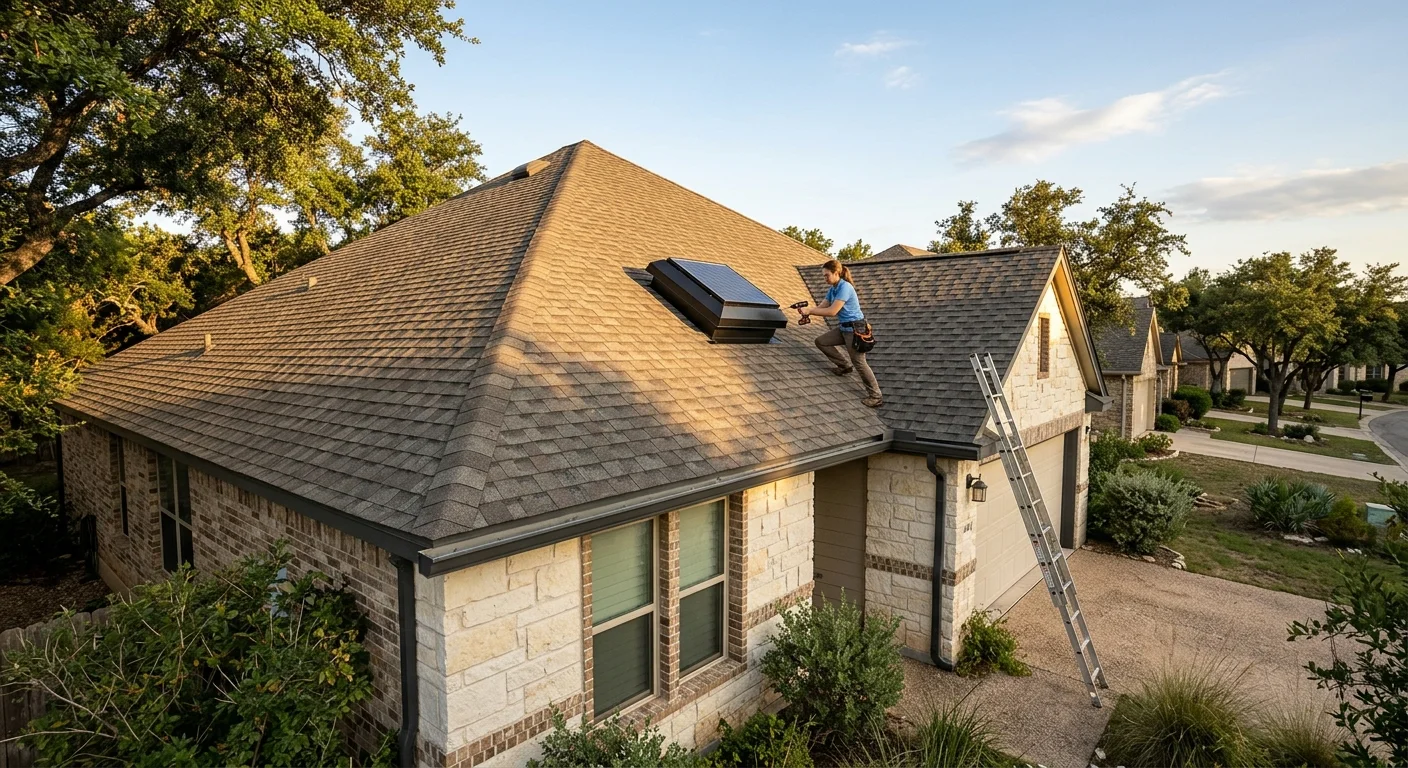
On the roof they mark a high location, then cut shingles and decking to the opening the manufacturer calls for. They set the flashing and hood so a Central Texas storm sheds around the unit, not into the wood. From the attic they fasten the housing and confirm the blade clears trusses, braces, and wire runs.
A solar unit gets its panel aimed at open sky. A hardwired unit gets a real circuit. Either way, the last step is a spin test and a close look at the seal. The pro should also say whether your soffits can feed the fan. That call is made in the attic, not from the street.
Round Rock and Pflugerville production roofs often already have ridge vents. Urban-core bungalows may have one gable vent and a tight hatch. Hill Country metal needs a flashing kit that matches the panel profile. None of those is a generic box swap.
Solar vs. hardwired paths on Austin roofs
Two power paths show up on Austin roofs. A solar attic fan uses a panel on the hood or beside it. It runs when the sun hits the roof, which is when attic air is at its worst. There is no branch circuit to pull through the house. There is still a hole in the roof, and the panel still has to see sky. Pecan shade on the east side of a Zilker or Tarrytown lot can starve a panel in the morning. A west slope in Bee Cave may sit in sun all afternoon.
If that is the unit you want, start with solar attic fan installation. Our guide to solar attic fans in Austin covers why people pick them in this climate. This page stays on the work itself.
Solar has real limits. The fan sits still at night and under heavy cloud. It does not cool living rooms by itself. It only moves attic air, and only while it has light. Those are the disadvantages behind the usual search questions. A hardwired fan on a thermostat can keep exhausting after dark, when the deck is still hot.
Hardwired work mixes trades. Texas does not license general or roofing contractors statewide. Electrical tie-ins are TDLR-licensed. The roof cut and the wire run may be two people on one job. Older panels and crowded junctions in central-city bungalows can turn a simple tap into extra electrical work. No wattage, breaker size, or labor hours are confirmed here. Those belong on the quote after someone opens the panel and the attic.
Metal versus shingle changes the flashing, not the idea of the fan. Architectural shingle is the common cut in East Austin and along the north corridor. Standing-seam and exposed-fastener metal show up more in western Travis and Hays County. The pro has to flash the roof you actually have.
HOAs in Steiner Ranch and Circle C may care about a hood on the front slope. We could not confirm a metro-wide HOA rule for attic fans. Ask the association before anyone cuts.
Attic access, wiring, and roof penetrations
Access is the part most people skip in their head. A small closet hatch, a maze of knee walls, or a spray-foamed roof deck all change the job. If the contractor cannot get a body and a housing to the peak, they cannot set the fan where it belongs. Some South Austin ranches are open and easy. Some two-story plans in Georgetown put the hatch over a garage and the target bay over a bedroom. The inspection is how that gets sorted.
Wiring follows the power choice. Solar keeps most electrical work on the roof and at the fan. Hardwired work needs a defined path, a junction, and a disconnect that matches the listed unit. Do not pick a wire size from an article. Have the electrician on the job read the nameplate and the panel.
The penetration is the leak risk. Austin thunderstorms drive rain sideways. A weak boot or a sloppy shingle merge shows up on the ceiling below, often on the first hard storm. Flashing has to match the roof material. A tube of sealant is not a flashing kit.
After the September 24, 2023 hailstorm, many Williamson and Travis County roofs took real hits. Round Rock saw hail up to about 4 inches. NWS and NCEI figures put combined losses for those two counties at about $600 million. If the deck is bruised, a new hole should wait on a roofing repair. Cutting through damaged sheathing is a leak waiting for the next cell.
Intake still belongs in this conversation. A fan is only an exhaust. Replacement air should come from the soffits. If the eaves are closed or the baffles are packed, that work should sit on the same quote. Skipping it is how a new fan steals air from the house.
Permits are not confirmed in our claims ledger for attic fans. We could not find a published City of Austin, Williamson County, or Hays County rule that names this unit and a fee. The contractor should check the desk that has your address before they cut. A Travis County house and a Kyle house in Hays County do not share one permit counter.
How this differs from a whole house fan job
An attic fan and a whole house fan are not the same install. Local results also mix in garage fans and ceiling fans. Those are different holes in different places.
An attic fan sits in the roof or high in a gable and exhausts attic air. Windows stay shut. The living space is not the air source. Whole house fan installation is a ceiling-mounted fan that pulls room air up through the attic and out the attic vents. You open windows. You run it when outdoor air is cooler than the house.
That job needs a ceiling opening, a shutter, and enough attic exhaust so the fan is not pushing against a closed roof. It also behaves differently on humid Austin nights. A whole house fan can bring moisture inside if you run it at the wrong time. An attic fan does not wash the house with night air. It only unloads the attic.
For the comfort comparison, read attic fan versus whole house fan in Austin. For this page, remember the scopes. Attic fan work is a roof cut, roof flashing, and an attic housing. Whole house fan work is a ceiling cut, framing, a shutter, and a check that the attic can relieve the air. Mixing those on one quote is how people buy the wrong machine.
Garage exhaust fans vent a garage, often through a wall. They are not attic fan installation near me, even when a roofing crew offers both.
What should show up on the installer quote
Ask for an itemized quote after the attic inspection, not a single lump line. You want the fan model and whether it is solar or hardwired. You want the mounting type. You want roofing work called out: the cut, the flashing, the seal, and the shingle or metal repair around the opening. You want electrical as its own block on a hardwired job, including who handles the TDLR-licensed tie-in.
Include intake work if soffits are blocked. Include removal of an old fan and a patch at the abandoned hole. Include protection for the rooms below and debris haul-off. If a permit applies in your city or county, it should be a line, not a surprise.
Manufacturer equipment warranties belong to the manufacturer. They are not a warranty from Bright Sky ATX. Bright Sky ATX is a referral service. We match you with experienced, insured independent pros. You contract with that contractor and you pay that contractor.
We do not publish job prices here. Market cost talk lives on attic fan installation cost in Austin, and even that page cannot replace an inspection. Labor hours, wattage, and CFM were not confirmed for this article. If a figure is not on your written quote, do not budget it.
Sizing comes up on almost every call, including what size you need for a 2,000 square foot house. Floor area is not attic volume, and it is not sun load. A one-story ranch in Buda and a two-story in Cedar Park with the same square footage do not share one attic. Start with solar attic fan sizing and then have the pro measure the space you have.
How many degrees an attic fan cools the attic is also unconfirmed here. It depends on intake, insulation, roof color, shade, and whether the fan is fighting other vents. The U.S. Department of Energy heating and cooling pages explain why attic heat reaches the rooms below. They do not replace a site check. The Texas State Energy Conservation Office is the state energy office if you are comparing upgrades.
The federal 25C credit expired for installs after December 31, 2025. Treat any tax-credit claim as something to confirm at quote, not as a figure on this page.
When to call us
Call when the attic stays hot, an old fan is dead, or you want a solar or hardwired unit set with a real flashing job. That is roof work, and on hardwired units it is electrical work too. Call us at (737) 477-8898 and we will match you with a licensed local pro.