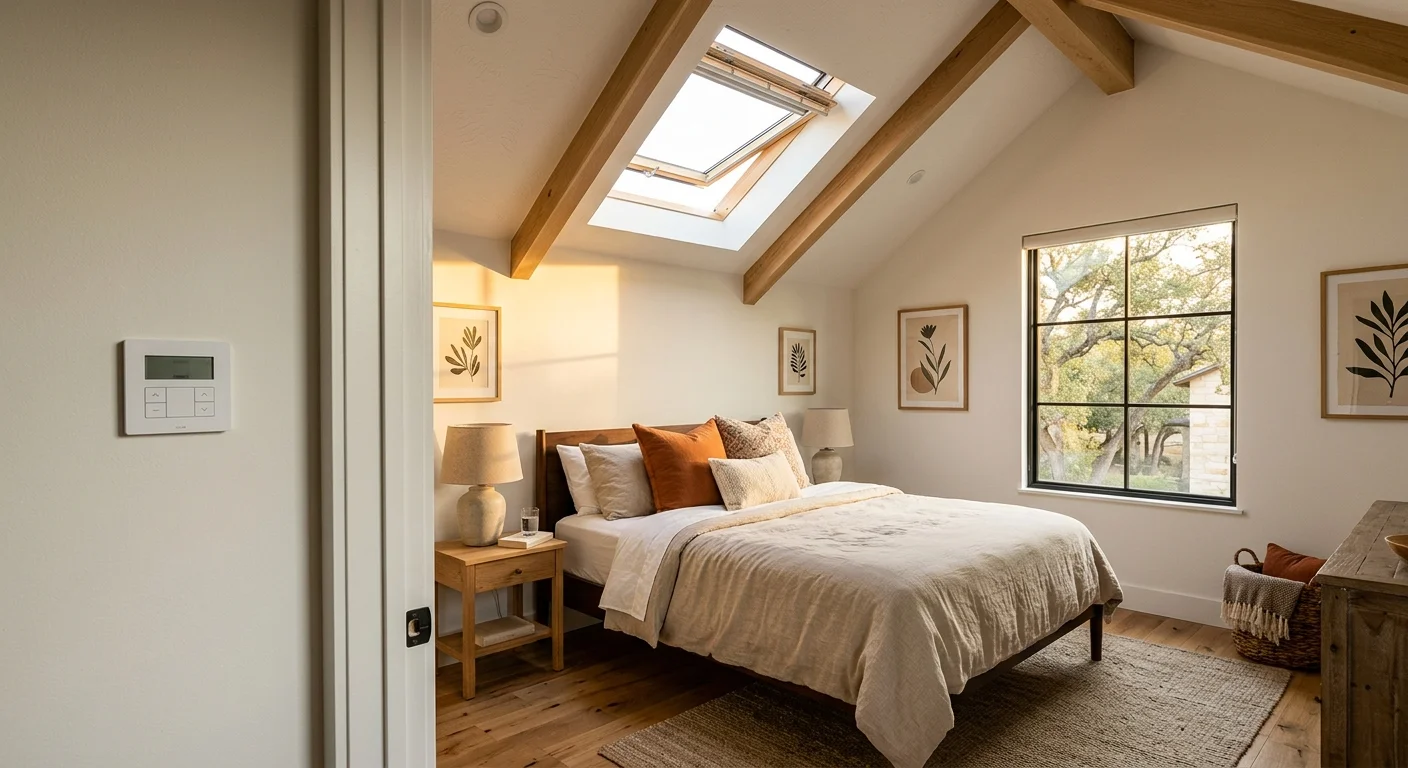
A vented skylight on an Austin roof sits out of reach. You’re picking a pole or a motor to open that sash in Central Texas heat. Roof-window operators are a separate comparison.
img src=“/images/blog/electric-vs-manual-skylights-austin-hero.webp” alt=“Austin bedroom with a vented skylight and a simple wall control in warm afternoon light” />
What electric and manual skylights each do
Electric vs manual skylights is an operator choice on a vented unit. It’s not the same decision as vented versus fixed. A fixed skylight doesn’t open. A vented one does. Once you want that sash to move, you pick the hardware that moves it.
A manual skylight uses a crank, a rod, or a pole hook. You stand in the room and turn the latch. That’s simple hardware. There’s no motor to fail. There’s no wall control to place. It works when a pole can catch the hook from the floor.
An electric skylight uses a motor in the frame or operator. You open and close it from a wall pad or a listed remote. Don’t assume a remote ships with every unit. Don’t assume a rain sensor does either. Those are options on some lines. They’re not a factory rule.
Power is the other split. Some electric operators tie into house wiring. Some use another listed power source on the spec sheet. This page can’t confirm which method a given model uses. Read the manufacturer sheet with an independent installer before you treat power as settled. If the listed source is a roof panel, that is a solar-powered venting skylight, not a wall-pad circuit.
Both types still need the same roof work. Flashing, glass, and mount style don’t change because the sash has a motor. Skylight installation is still a roof penetration in Travis, Williamson, or Hays County. The operator is one line on that spec. It’s not a different product family.
Manual units suit rooms you stand in every day. They suit a ceiling a pole can reach. Electric units suit sashes you won’t touch from the floor.
Why Austin heat and roof access change the choice
Austin is not a mild-sun market. City of Austin residential energy code uses Climate Zone 2. For skylights, the published maxima are U-factor 0.60 and SHGC 0.28. Those figures sit in the 2024 tables for existing buildings and new construction. They’re glass and frame ratings. They’re not an operator promise. A motor doesn’t make a hot pane cool. Low SHGC glass still matters on a west run in Allandale.
Heat changes how often you’ll actually open the unit. A vented skylight helps when the room can dump air. It hurts when you leave it open under a July sun. If the control is a pole in the closet, the sash stays put. If the control is on the wall, they close it when the room spikes.
Roof access is the other Austin split. Hill Country west of the city often means a steep pitch and metal. Bee Cave and Dripping Springs see this a lot. A pole from a downstairs floor may never reach a high north slope. Climbing for a stuck crank is a roof job.
North corridor houses stack height in a different way. Cedar Park, Round Rock, Pflugerville, and Georgetown do this a lot. A second-story landing can put a skylight over a void. You see the glass. You can’t stand under the hook.
Central and East Austin bungalows can go the other way. Lower plates, reachable ceilings, a pole that works. Manual can be the honest pick on those roofs.
The U.S. Department of Energy’s home heating and cooling guidance is a useful frame. Use it for when to vent and when to keep the house closed. Pair that with the glass rating, not a savings guess. No dollar savings figure for an electric skylight Austin install could be confirmed here.
Rain sensors, shades, and glare control
A rain sensor isn’t standard on every electric unit. Some models offer it. Some don’t. Confirm it on the manufacturer sheet. Austin pop-up storms move in fast off the I-35 corridor. A vented sash left open through that cell dumps water into the well. A sensor that closes the sash helps only if that model includes it.
Manual units have no sensor. You’re the sensor. That’s fine if you’re home. It’s a poor plan for a weekday while you’re at work in Kyle or Buda. Hays County houses in Buda and Kyle sit in the same storm path as south Travis. If nobody’s home to pull a pole, an electric close is the practical difference.
Shades are a separate layer. An operator that opens glass doesn’t control glare by itself. West light in a South Lamar office can wash a screen by midafternoon. East-facing glass is kinder in summer. West-facing glass is the glare and heat problem. Skylight blinds and shades sit inside the well or at the glass, depending on the system. Ask whether the shade is manual, electric, or listed as compatible with the same control. Don’t assume one wall pad runs both the sash and the shade. That pairing is model-specific.
Glass still does the heat work. SHGC and glazing for Austin heat is the rating conversation. U-factor 0.60 and SHGC 0.28 are the published city maxima. A specific product’s numbers could not be confirmed here. Check the rating label on the unit with the installer.
For glare at a desk, the well depth and the shade matter as much as the motor. A home-office glare problem doesn’t get solved by a remote alone.
Rooms where remote operation pays off
Remote operation pays off where you can’t stand under the hook. A two-story living room in Leander or Cedar Park is the classic case. So is a stairwell well in a Steiner Ranch plan. So is a master bedroom where the glass sits over the bed. You won’t keep a pole next to the nightstand.
Hays County two-stories in Kyle often put a well over the entry. That glass is for light. It’s a poor place for a pole. Williamson County bonus rooms over the garage have the same reach problem.
Kitchens with a vaulted ceiling on a South Austin ranch can go either way. If you cook under the well, a pole is in the way. If the island is offset, manual can still work.
Hall baths and powder rooms are a maybe. A small operable unit can dump steam. A pole over a toilet is awkward. An electric pad outside the wet zone is cleaner. Don’t treat that as a ventilation code claim. Confirm bath venting with the installer and the city.
Over a shower is a harsher setting. Water, steam, and a sash you can’t reach from the stall. If you want that unit operable, remote control is the honest layout. If you don’t need the vent, a fixed unit avoids the operator entirely.
Single-story ranches in south Travis with eight or nine foot plates are where manual still wins. You can see the hook. You can reach it. You’re not paying for a motor you’ll never miss.
The manual skylight vs electric call is reach, heat, and whether anyone is home. A home office still needs a shade for glare.
What to confirm before you pick a model
Sit with the manufacturer sheet and an independent installer. Don’t pick the operator from a catalog photo.
Confirm whether the unit is vented or fixed first. If you don’t need the sash to open, skip the motor. Then confirm how this model actually opens. Pole, crank, wall pad, remote, or another listed control.
Confirm power. Ask whether the operator is hardwired or uses another listed source. If it needs house wiring, ask who makes that connection. Ask what Austin, Round Rock, or your county wants for that step. A specific permit rule for that electrical step could not be confirmed here. Treat it as a question for the contractor and the city.
Confirm rain sensor, shade, and whether one control runs both. Confirm U-factor and SHGC against the City of Austin maxima of 0.60 and 0.28. Read those numbers on the unit’s rating label. ENERGY STAR’s skylight criteria are a second check, not a substitute for the city tables. The Texas State Energy Conservation Office collects statewide efficiency programs. Any rebate or tax-credit dollar amount is outside what this page can publish. Confirm current incentives at quote time, not from a blog.
Confirm the roof. Metal in the Hill Country, composition in much of Pflugerville, low-slope on some east-side additions. Flashing follows the roof, not the motor.
Confirm reach. Stand in the room with the installer and look up. If you can’t say how you’d close it at 5 p.m. in August, skip the pole.
Bright Sky ATX is a referral service for the Austin metro. The contractor you’re matched with is who sizes the unit. Ask them to put the operator, glass, and flashing on one written spec.
When to call us
When the sash sits out of reach, this isn’t a weekend pole swap. The same is true when the operator needs house wiring. Call us at (737) 477-8898 and we will match you with an experienced, insured local pro.