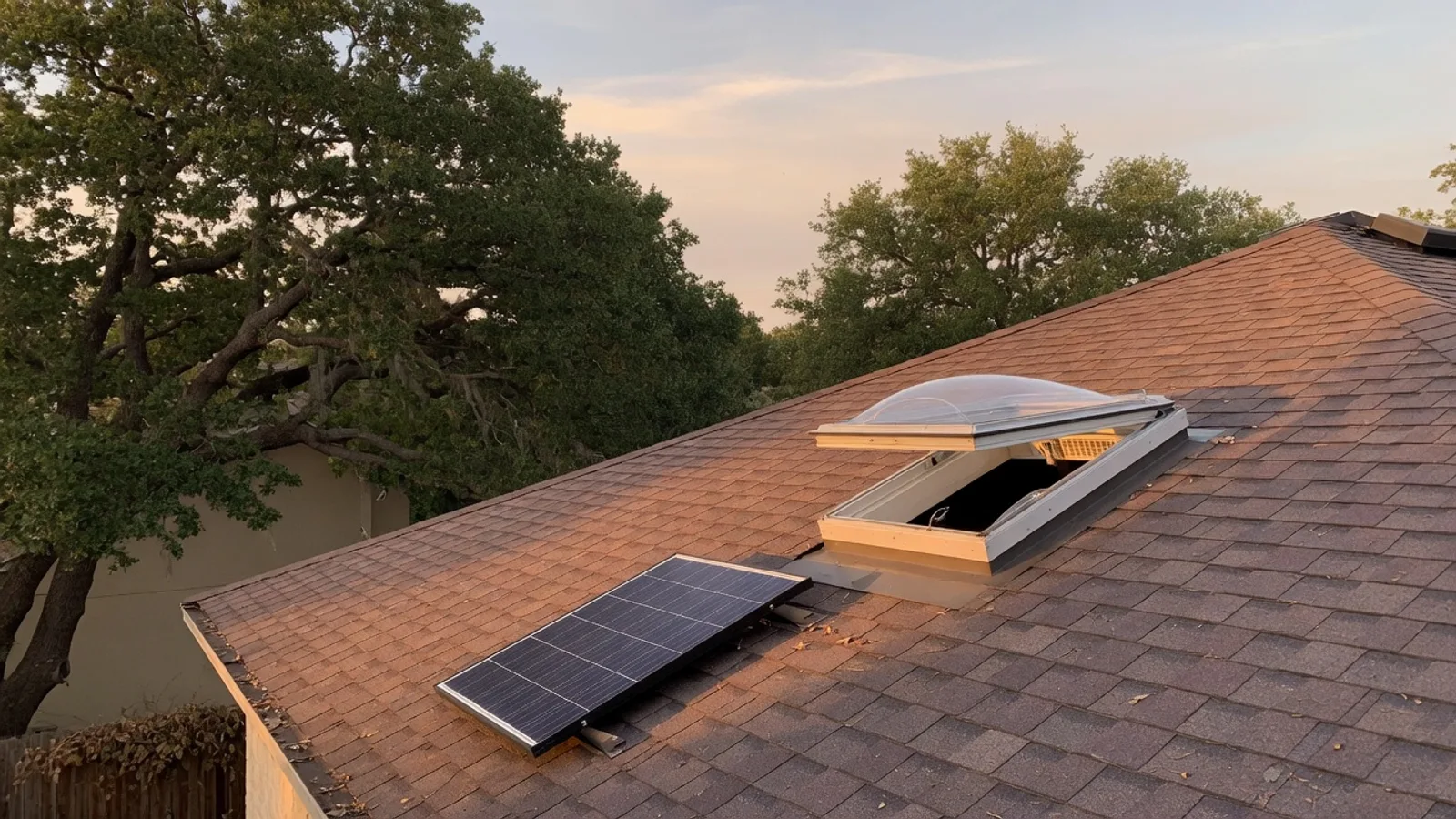
A solar-powered venting skylight opens because a listed photovoltaic panel on the roof feeds the operator. It is not a pole. It is not a hardwired wall pad. Homeowners mix those three after reading a catalog photo. Bright Sky ATX is a referral service. The pro you hire names the operator on the sheet. We do not.
Three different objects
Vented versus fixed is whether the sash opens at all. If it stays shut, skip this page.
Electric versus manual is how a vented sash moves when the power comes from the house or from a pole in the room. A solar-powered operator is a third path: the panel on the roof, or next to the curb, is the listed source. There is no assumption that a circuit already exists in that well.
Ask the installer to point at the source on this model. Panel on the sash. Panel on the same roof plane. Battery pack listed on the sheet. If they cannot name it, you are still shopping.
A rain sensor is not automatic on every solar operator. Confirm it on the manufacturer sheet. Austin pop-up storms move in fast off the I-35 corridor. A sash left open through that cell dumps water into the well. The sensor helps only if that model includes it and it still works after hail.
What the panel does not do
The panel does not change City of Austin Climate Zone 2 maxima for skylights: U-factor 0.60 and SHGC 0.28. Those numbers sit on the glass and frame. They sit in the 2024 tables for existing buildings and new construction. A motor that runs on sun still needs a labeled pane. SHGC and Austin heat is the rating page.
The panel does not replace a bathroom exhaust fan. It does not replace air conditioning. Opening a sash on a 100-degree afternoon can pull hot air in. The U.S. Department of Energy heating and cooling guidance is the right frame for when to vent and when to keep the house closed.
The panel does not flash the roof. Flashing still follows shingle, tile, standing-seam, or a low-slope curb. Hill Country metal west of the city is a different pan than a Manor composition roof.
A specific wattage, battery hour figure, or “works through cloudy weeks” claim could not be confirmed here. Read the listed source on the sheet with the installer.
Where a solar operator is the honest pick
A two-story well in Cedar Park or Leander where no one will run a pole. A Kyle or Buda entry well on a Hays County two-story. A room with no spare circuit in the well, and a homeowner who does not want that circuit pulled.
Where it is a poor pick: a reachable single-story ranch in south Travis, where a pole still works. A roof plane already packed with other penetrations, where a second panel fights for sun. A lot that sits in heavy tree cover all afternoon, where the listed source never sees the sky it was sized for. Confirm shade on that plane at 3 p.m., not at 9 a.m.
Hail still hits the glass. The September 24, 2023 storm was the costliest Austin-area hailstorm on record, about $600 million in estimated losses across Travis and Williamson counties, with hail up to about 4 inches in Round Rock. Ask whether the operator and the pane are specified for that weather, separately. Impact-resistant glass is the glazing follow-on.
How Bright Sky ATX fits
We match homeowners in Travis, Williamson, and Hays counties with independent skylight professionals. The pro you hire inspects the roof and, if the unit belongs, installs. We do not. We do not set prices. See skylight installation.
When to call us
Call when you want the sash to open and you need the power source named on this roof, not guessed from a catalog. Call (737) 477-8898.