A finished attic in Round Rock has to work as a room, with real light, on a roof that was framed for storage. Most of the two-story stock in Teravista, Forest Creek, and Paloma Lake was built that way. Roof windows are the daylighting piece that turns that slope into something you can live under.
How Round Rock attics differ from central Austin
Drive the I-35 and SH 45 edge of Williamson County and the roof lines start to repeat. Two-story production houses. Shingle slopes. A short attic above the second floor. That attic was framed around trusses, HVAC trunks, and a ridge sold as storage.
Hyde Park and Allandale bungalows in central Austin grew up on a different pattern. Many of those roofs are stick-framed. The attic is the whole volume of a one-story house. Headroom gathers near the ridge. A daylighting unit there sits over a single occupied floor.
Round Rock’s 1990s and 2000s tracts along University Boulevard, Gattis School Road, and A.W. Grimes tell another story. Living rooms and primary bedrooms already fill two floors. The leftover attic is a wedge. Knee walls sit low. Truss webs cut the volume into triangles. Plenty of these two-stories already have a media room or a bonus room over the garage, common in Forest Creek and on the newer Paloma Lake streets, with one small gable window and a long dark slope.
That slope is where a roof window earns its keep. It faces the sky the gable never sees. It sits in the plane the room already has. Some houses will still need framing changes. An independent installer has to read the truss before anyone cuts.
Teravista’s golf-course streets, the Brushy Creek edge, Vista Oaks, and the houses that back toward La Frontera share Austin’s climate. Those roofs were built for two finished floors and a storage attic. Summer heat sits on the west and south slopes for hours. The September 24, 2023 hailstorm put stones up to about 4 inches on Round Rock, with about $300 million in losses in Williamson County. Read the local Round Rock hail history before you pick glass. Confirm current product ratings with the installer on site. Confirm the city’s rules with the City of Round Rock before work starts.
When a roof window is the daylighting choice
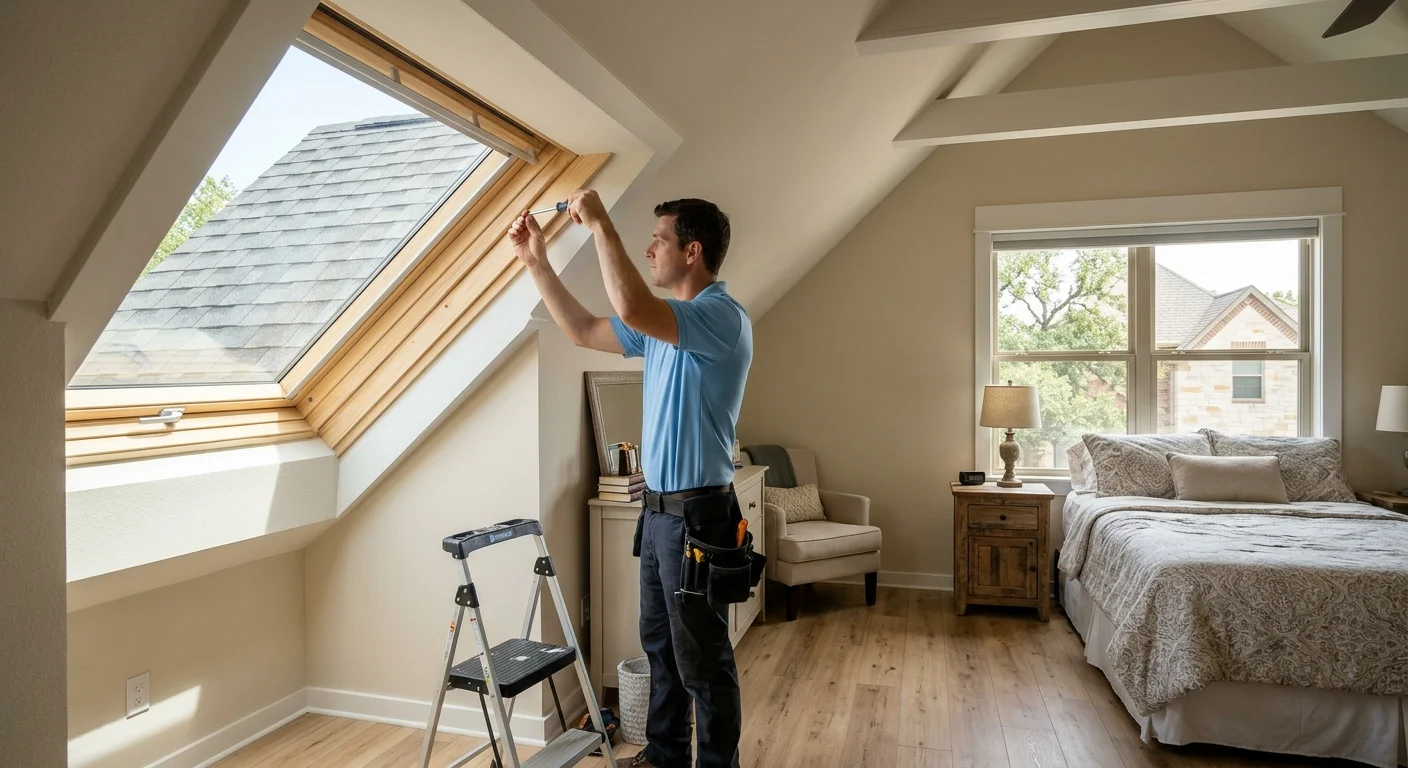
A roof window is the daylighting choice when the attic is going to be a room you stand in. You want glass you can walk up to. You want a sash that opens. You want a sill in the slope, with a view, in a space that used to be storage.
The split between roof windows and skylights is the short version. Skylights often sit higher in the plane. Many are fixed. Vented skylights help with heat, and they still read as a ceiling unit. Roof windows are built for occupied roof space. In a roof window attic bedroom, that difference is the whole point.
Solar tubes and sun tunnels punch a beam of light into a closet, a powder room, or a dark hall. A desk and a bed still want glass you can look through, and a sash that can open after a Round Rock afternoon. If the plan is an office or a guest room over a Forest Creek garage, a tube is a supplement.
Skylight installation still belongs in the conversation when the space below is a stair, a hall, or a second-story landing that only needs light. The converted attic itself usually wants the operable unit.
Orientation matters on these tracts. A west slope off University Boulevard takes late sun and a long bake. A north slope stays softer. South glass in Central Texas is a heat load you design for. Look at ENERGY STAR’s window, door, and skylight criteria with your installer, then confirm what the City of Round Rock will accept. City of Austin energy tables are published for Austin. Round Rock sets its own path.
Shades belong in the same decision. A roof window without a shade on a west Paloma Lake slope will glare at 4 p.m. in August. Motorized or manual is a later choice. The first choice is whether the unit can take a shade at all.
When the gable already has a window, keep it. Then ask whether the long slope still leaves a dark half of the room. In a lot of these bonus rooms, that is the moment a roof window is the right tool for an attic conversion in Round Rock.
Egress, heat, and two-story plans in new tracts
If the attic is going to be a bedroom, emergency escape is part of the plan. The exact opening size, sill height, and path to grade are set by the building official who will review the job. Those figures are not in our verified ledger, so they are not printed here. The City of Round Rock is the authority. Ask the city before you order glass.
Austin has its own conversation, and we already wrote it: egress roof windows in Austin. Round Rock is a separate city in Williamson County. Bring the Round Rock address to the Round Rock counter.
Heat is the other constraint two-story tracts put on the glass. The room sits under the roof. Little attic remains above it once you finish the space. Summer sun on a shingle slope in Round Rock is the Central Texas load the U.S. Department of Energy describes for home heating and cooling. Low solar-heat-gain glass, exterior shading, and a unit that can open at night are the practical tools. The Texas State Energy Conservation Office keeps statewide energy-code context on the comptroller’s SECO page. Round Rock’s adopted path is a question you confirm with the city. Austin’s published skylight maxima are U-factor 0.60 and SHGC 0.28 in the 2024 residential energy tables. Those figures apply to Austin. Treat them as a nearby benchmark, then verify Round Rock.
Two-story plans add a third issue. You are cutting a roof that already covers finished bedrooms below. A leak shows up as a ceiling stain in a second-floor room. Flashing, underlayment, and the way the unit meets a truss web are the installer’s problem to solve on site. Some trusses can be altered with an engineer’s letter. Some stay as they are. That call is a site call.
New tracts east of A.W. Grimes and north toward the Kalahari side of town often stack HOA roof-material rules on top of the city’s. Structure, heat, and the escape path all have to clear before a design committee weighs in on the glass.
HOA and city paths you still have to confirm
The City of Round Rock reviews building work inside the city. That includes attic conversions and new roof openings when the city requires a permit for them. We could not confirm a permit fee, a named ordinance, or a published checklist against our verified ledger. Call the City of Round Rock and ask about your address before anyone cuts the roof.
HOA review is a second path, and it is common on the master-planned streets this search is about. Teravista, Forest Creek, Paloma Lake, and Vista Oaks run design guidelines that already speak to roof changes, glass, and street-facing slopes. HOA approval for skylights in Texas is the process overview. Your covenants are the document that binds you. Get that packet from the management company. Put the roof-window spec in front of the committee in the form they ask for.
Street-facing slopes get more review than a rear slope over a backyard. A unit on the rear of a Paloma Lake house, looking toward open space, is a different packet than a street-facing unit on a Teravista cul-de-sac. The installer can speak to flashing and structure. The committee speaks to appearance. Take photos of the street elevation and the rear slope. Committees ask for both more often than homeowners expect.
A Brushy Creek address can sit in a patchwork. Confirm whether the City of Round Rock, Williamson County, or an HOA has the stamp on your lot. Those are three different stamps. Bright Sky ATX matches you with an independent, insured pro. That pro still works under the rules of the lot.
Start with the city, the covenants, and a site visit. Glass that fails review sits in a crate.
What an independent installer checks on site
The contractor you are matched with should walk the roof and the attic. A photo leaves the trusses, the slope, and the rooms below unseen. On Round Rock two-stories, the checklist is local.
They look at the covering. Shingle is common on these tracts. Flashings change if a later owner put metal on a porch or a whole slope. They measure slope, because a roof window needs a pitch it is rated for. They look at truss layout versus a rafter roof. They note HVAC trunks and bath fans that already occupy the volume. They check headroom at the planned sash. A unit at shin height is a trip. A unit at the ridge in a low truss attic may sit out of reach.
They look at the rooms below. A roof window over a second-story bedroom has to flash as if the ceiling under it is finished, because it is. They plan interior liners and shades. They sort manual versus motorized. They tell you if the better daylighting tool is a roof window, a skylight, or both.
Hail history belongs in that visit. After the September 2023 storm, laminated or impact-rated glass is a fair question. We do not have a verified Round Rock code section that requires a given rating. Ask the installer what they specify on Williamson County roofs, and confirm with the city.
Bright Sky ATX is a referral service. We match you with experienced, insured independent skylight pros. We perform no work, own no trucks, and hold no contractor license. You contract with the pro directly. Get that pro on the roof before you pick a catalog size.
When to call us
If the attic is becoming a bedroom or office, and the slope needs operable glass, you want an independent skylight and daylighting pro on site before you order a unit. Call us at (737) 477-8898 and we will match you with a licensed local pro. Bring the address, the HOA packet if you have one, and a clear photo of the slope you want to open.