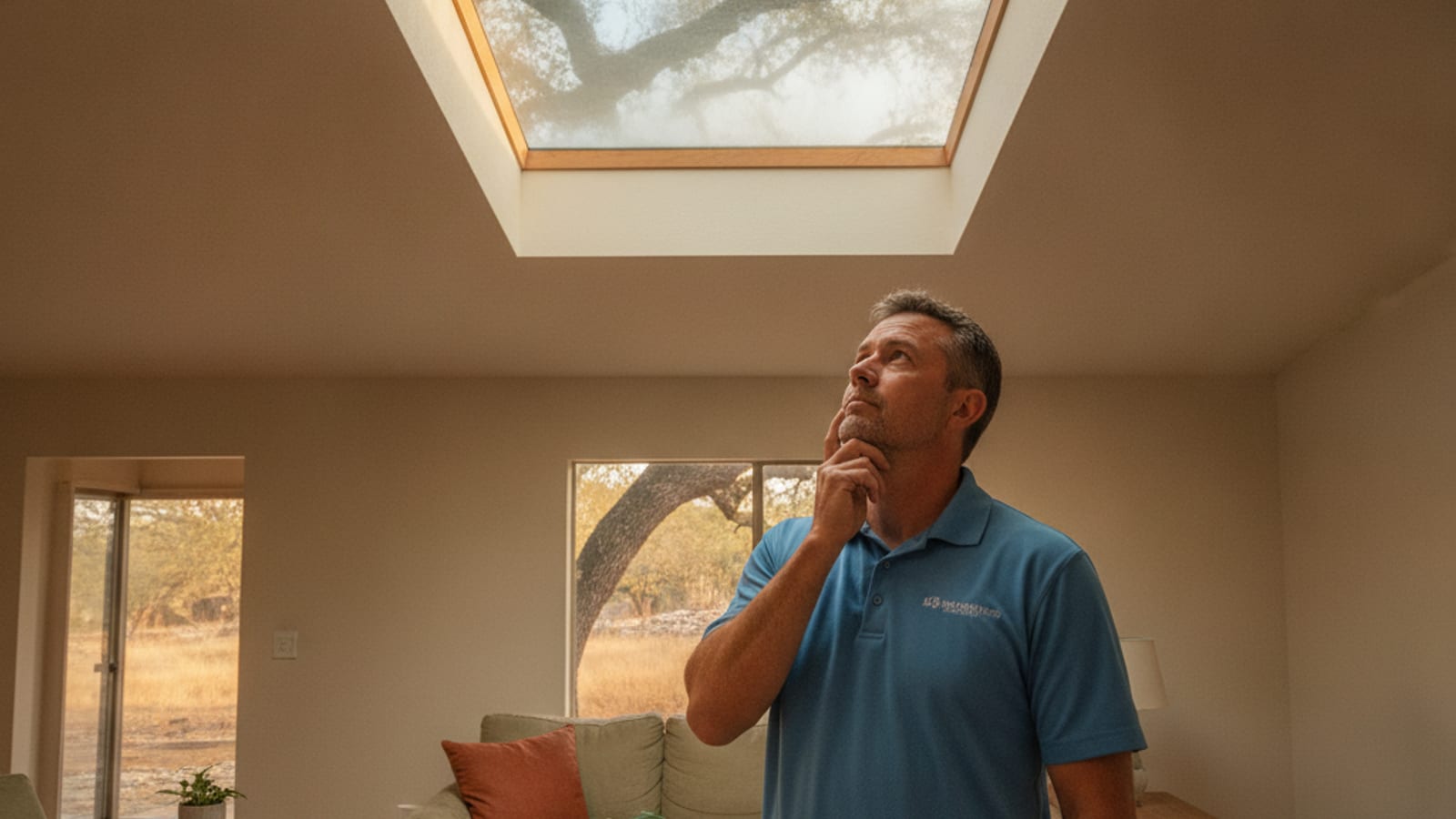
Moisture around your skylight with no recent rain is almost always condensation, not a leak. Staining that follows a rain event by a few hours, on the other hand, points to an actual leak. That timing test is the fastest way to tell the two apart, and it’s worth running before you assume the worst or call anyone out.
Why Austin skylights sweat
Central Texas humidity swings hard, both by season and by time of day, and that’s the root cause of most skylight condensation here. Austin sees roughly 35 to 36 inches of rain a year, but it’s concentrated into about 86 rainy days, with May the wettest month at around 5.6 inches over 9 days. The rest of the year runs drier, with humidity still swinging widely between a warm, moist evening and a cool morning. When warm, humid indoor air meets a cold skylight surface on one of those cool mornings, water condenses on the glass, just like it does on a cold glass of tea in July. It’s a temperature-difference problem, not a roof-failure problem.
The five-minute diagnostic checklist
Run through this before assuming a leak:
- Check whether it rained in the last several hours. If not, and the room is warm and humid, condensation is the likely cause.
- Look at where the moisture sits. Condensation tends to form as an even film or droplets across the glass surface. A leak tends to show as a stain trailing from one point, usually the frame or a corner.
- Touch-test the glass. If it’s cool to the touch and the room is noticeably warmer and more humid, that temperature gap points to condensation.
- Check the timing pattern over a few days. Condensation that shows up on cool, humid mornings and clears by midday is a repeating pattern tied to weather, not plumbing.
- Look for a brown or yellow tint to any staining. Clear water pooling reads as condensation; discolored staining reads as a leak that’s picked up contaminants from wood or drywall.
Surface condensation vs. between-the-panes fogging
There’s an important distinction here. Surface condensation on the room-facing side of the glass is usually a humidity issue you can manage. Fogging that shows up between the panes of an insulated glass unit is a different problem entirely: it means the seal between the panes has failed, letting moisture in where it can’t be wiped away. That’s not a towel-and-dehumidifier fix. It calls for a skylight glass replacement, since the sealed unit itself has to be swapped.
When condensation is actually the problem to solve
Bathrooms and kitchens generate a lot of moisture fast, from showers and cooking, and if that moisture vents up toward a nearby skylight well before it has anywhere else to go, condensation there can be a real, recurring nuisance rather than just an occasional morning film. The fixes here often cost nothing: run the bathroom fan longer after a shower, crack a window briefly, or use the kitchen exhaust fan while cooking. Some vented skylight models also allow trickle venting, a small adjustable gap that lets humid air escape gradually without fully opening the unit.
When to call someone
If the moisture pattern doesn’t match the condensation profile, meaning it shows up regardless of humidity or clearly follows rain by hours, or if you’re seeing between-the-panes fogging that never clears, it’s worth having someone look at the flashing and seals directly. A trained eye can usually tell the difference from the roof and the room in one visit.
Why does my skylight drip in winter?
Winter often brings the biggest indoor-outdoor temperature gap of the year, which is exactly the condition that produces the most condensation on a cold skylight surface, especially in a humid room like a bathroom.
Is fog between skylight panes fixable?
The fogged glass unit itself needs to be replaced; the failed seal that let moisture in can’t be dried out or resealed from the inside. A skylight repair technician can confirm whether a glass swap or a full unit replacement makes more sense.
Does a vented skylight stop condensation?
A vented unit with trickle venting can help release humid indoor air before it condenses, but it won’t eliminate condensation entirely in a consistently humid room. It’s a mitigation, not a guarantee.
If you’re not sure
When the pattern doesn’t clearly match condensation or a leak, an inspection settles it fast and saves you from either ignoring a real leak or worrying over nothing. Bright Sky ATX connects Austin homeowners with experienced, insured local crews for skylight replacement and repair. Call (737) 477-8898 for a free estimate.