A clay or concrete tile roof in West Lake Hills can take a skylight. The opening, the curb, and the flashing have to follow the tile courses, which is a different job than shingles or standing seam. The only way to know if your roof can take the cut is an on-site roof and attic check by an independent installer.
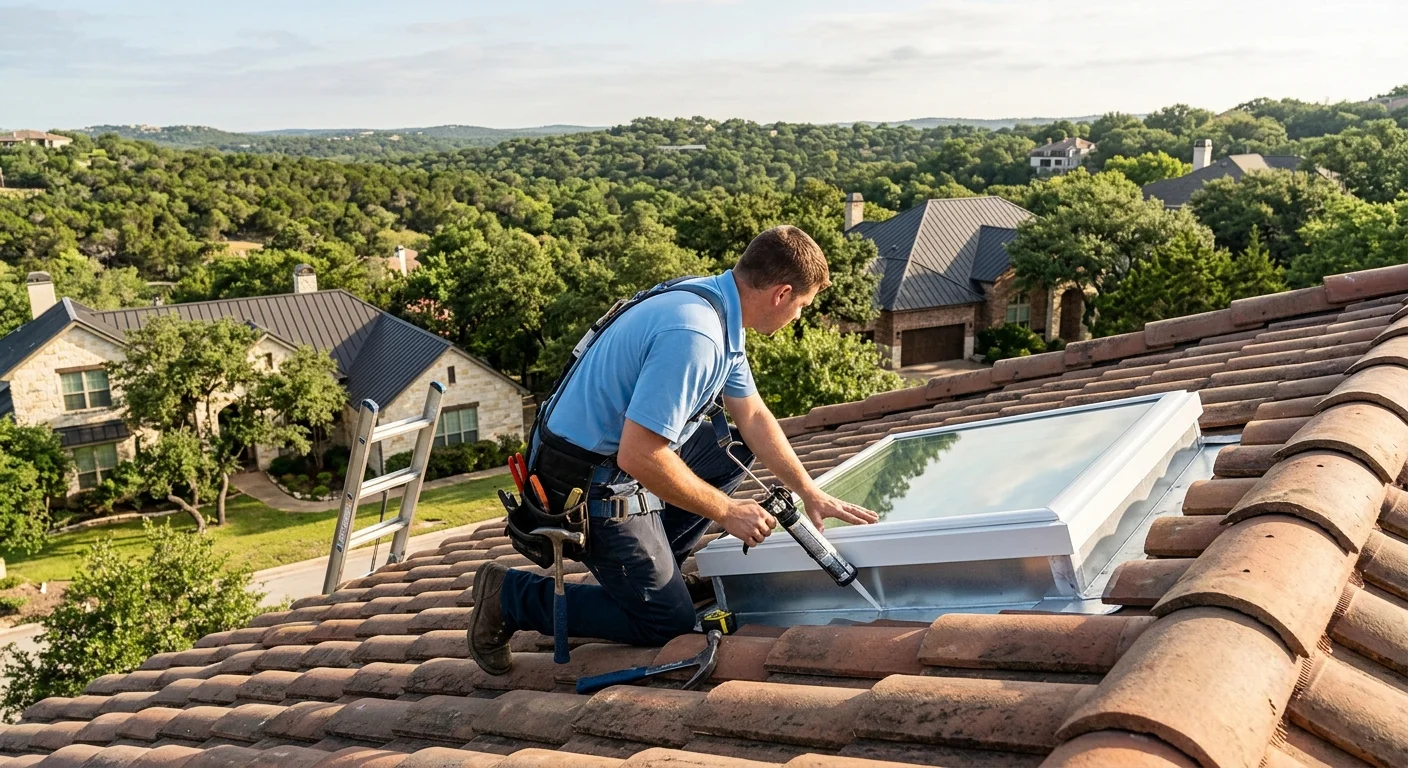
Why a tile roof is a different skylight job
Tile is a system of overlapping units, not a sheet. Each piece sheds water onto the course below it. When a rectangular opening goes in for a skylight, those courses have to stop, turn, and start again around a raised frame. Composition shingles can be sliced and sealed. Standing-seam metal is a different problem, and we cover that in metal roof skylight work in Austin. Tile is its own trade.
West-side custom homes use both clay and concrete. Clay often shows up on older West Lake Hills roofs and on houses that were built to read as Hill Country Mediterranean. Concrete is common on larger Barton Creek roofs. Either one can crack if someone walks it wrong or pries it with the wrong tool. Matching a broken barrel, S-tile, or flat concrete piece years after the house went up is a real constraint. The installer has to know whether spare tiles are stacked in the garage, tucked on a rack, or gone.
The stack under the tile matters as much as the tile. There is a deck, underlayment, and then the tile field. What that stack looks like on your house could not be confirmed from a listing photo or a street view. It takes a roof walk and an attic look. A blog cannot call the batten layout, the underlayment condition, or whether a valley already leaks into the cut zone.
Weight is part of the difference too. Tile is a heavy roof covering. A new curb and shaft add more load in a small area. No verified figure in our ledger sets a live-load or dead-load number for this work, so do not treat a neighbor’s job as your structural answer. The independent pro checks the framing they can see and tells you if an engineer needs to look at it.
Can you add a skylight to any roof is the general feasibility page. This one stays on tile, because west Austin tile is where the search actually lives. If you already know you want a full-size unit, skylight installation is the service path the matched contractor will quote against.
How flashing and curbs work with clay or concrete tile
Water on tile wants to run downhill in channels. A skylight sits in that path. A curb is a raised box that lifts the glass above the tile so water can pass around it. Flashing is the metal that ties the curb to the roof: a head piece upslope, side pieces woven into the courses, and an apron downslope. On a wide unit, some roofs also need a saddle or cricket so water does not pond against the upslope edge. That assembly is common practice. It is not a published Austin measurement.
Exact curb height, pan width, and how many tiles get pulled could not be confirmed as a single city or county rule. Profiles differ. A flat concrete tile does not flash like a two-piece clay mission tile. A used barrel tile from a 1990s West Lake Hills roof does not seat like a current concrete S-tile. The installer measures the unit and the course layout on your roof, then chooses a flashing kit that fits that profile. If a number for flashing height or tile count is not on the job sketch, it is not a fact.
Deck-mount units sit lower, closer to the roof deck. On tile, the thickness of the field can fight a low profile. Whether your roof wants a curb-mount, a deck-mount, or another assembly is an on-site call. Curb-mount versus deck-mount walks through that choice in general terms. Do not pick the mount from a catalog photo of a shingle roof.
The glass still has to meet energy numbers if you are inside the City of Austin. Austin’s residential energy code uses Climate Zone 2. For skylights the published maxima are U-factor 0.60 and SHGC 0.28, in the existing-building and new-construction tables. Confirm the NFRC label on the unit. ENERGY STAR publishes product criteria separately. The Texas State Energy Conservation Office is the statewide energy office. Those U-factor and SHGC figures are City of Austin tables. West Lake Hills is its own city. Parts of Barton Creek sit in Travis County or in an extra-territorial jurisdiction. Which code that lot actually uses could not be confirmed in our ledger. The installer checks the jurisdiction that issues the permit for your address.
West Lake Hills and Barton Creek roof patterns
West of Loop 360, lots climb the escarpment. Roofs are bigger, broken into hips and valleys, and often finished in clay or concrete tile. West Lake Hills sits in the trees above Lady Bird Lake and Bee Cave Road. Barton Creek runs south and west toward the golf corridor and the Edwards slope. Both are full of custom houses that chose tile so the roof would read as Hill Country, not tract shingle.
That is why a skylight on a tile roof in Austin is a west-side question. An east Austin bungalow is usually composition shingle. Plenty of Steiner Ranch and Circle C houses are shingle or metal. Tile clusters on the west side: West Lake Hills, Barton Creek, parts of Rollingwood, and similar custom streets toward Bee Cave. Swap the neighborhood name and the housing stock is wrong.
Trees matter here. Live oak and Ashe juniper drop debris into tile channels. A skylight on a shaded north plane over a wooded West Lake Hills lot behaves differently from one on a west plane that takes afternoon sun off limestone. Orientation is a comfort issue in Central Texas heat. The U.S. Department of Energy heating and cooling pages explain why glass and shading change load. They do not replace an attic check, and they do not set a west-side shading rule.
The Sept. 24, 2023 hailstorm was the costliest Austin-area hail event on record. Estimated losses were about $600 million for Travis and Williamson counties combined, about $300 million in each county. Round Rock saw hail up to about 4 inches. West-side tile can still crack from impact, even when the house sits west of that core. If tiles around a proposed opening are already broken, slipped, or patched, the installer should say so before anyone cuts. Hail damage on skylights versus the roof is the companion read if you are sorting storm damage from a new opening.
Some Barton Creek streets have a design-review board or an HOA. No verified rule in our ledger bans or allows a skylight in those associations. If you have CC&Rs, ask the association in writing before the roof is opened. The City of West Lake Hills and Travis County each run their own permit desk. Whether a new roof opening needs a permit on your lot could not be confirmed as a single answer here. Point the installer at Austin skylight permits and, if you are outside city limits, at ETJ permit questions, then have them confirm with the office that actually stamps the address.
When a solar tube is the smaller cut
A solar tube is a small roof dome, a reflective tube, and a ceiling diffuser. The roof cut is much smaller than a rectangular skylight. On tile, a smaller cut means fewer tiles lifted, fewer pieces to flash, and less chance you run out of matching tile. That is often the right move for a dark interior bath, a hallway, a closet, or a laundry room in a West Lake Hills plan that buried those rooms in the middle of the house.
It is the wrong tool if you want a view of the sky over a kitchen island or a stair hall. The tube gives a beam of light. It does not give the same opening, and it does not vent a room. Solar tube versus skylight in Austin is the side-by-side if you are still choosing.
Some custom roofs need both: a curb-mounted skylight in the main room and a tube in the tight bath. That mix shows up on large Barton Creek houses because the tile field is already expensive to open. Each hole has to earn its size. Do not pick a tube diameter from a catalog and call it a plan. The installer looks at the attic path, the ceiling location, and how many tiles sit over that spot.
A solar tube still needs flashing that follows the tile. A small dome does not make the water path simple. The same on-site rule applies: if the method is not measured on your roof, it is not confirmed.
What an independent installer has to inspect
The pro you are matched with should walk the roof and the attic. A photo of a West Lake Hills ridge is not an inspection.
On the roof they should name the tile (clay or concrete, and the profile), mark cracked or slipped pieces, note previous patches, and look at how valleys and walls are already flashed. They should propose an opening that lands between rafters if the layout allows, and they should tell you if it does not. They should also look for leftover tiles on site. If the color was discontinued, the conversation changes: salvage from a hidden slope, a close blend, or a smaller opening so fewer faces show.
In the attic they should check rafter layout, insulation, bathroom fans that dump into the attic, electrical runs, and HVAC trunks that sit where a light shaft would go. A shaft through a second-floor bonus room is a different job than an empty attic over a one-story wing. None of those conditions can be confirmed from the street.
For the unit, they should read the NFRC label: U-factor, SHGC, fixed or venting. City of Austin maxima are U-factor 0.60 and SHGC 0.28. Confirm whether your lot is actually in that city. They should also talk through the interior well: where it lands, whether a shower below wants moisture-rated detailing, and whether west sun needs blinds. Manufacturer warranties attach to the product, not to Bright Sky ATX. The homeowner contracts with the installer and pays that installer directly.
Texas does not, in our ledger, license general or roofing contractors statewide. Electrical tie-ins are a separate TDLR question when a venting unit needs power. Ask the independent pro for proof of insurance and for the product warranty in writing. Do not treat a blog as a substitute for that packet.
Tile roof skylight installation in this metro is a west-side, on-site job. Can you install a skylight on a tile roof? Yes, when the framing, the tile field, and the flashing path all check out. If any of those three is unknown, keep the saw on the ground.
When to call us
If you have clay or concrete tile in West Lake Hills, Barton Creek, or nearby west-side streets and you want a new roof opening, you need an independent skylight and daylighting pro on the roof before anyone cuts. Bright Sky ATX matches homeowners with experienced, insured local installers. Call us at (737) 477-8898 and we will match you with an experienced, insured local pro.