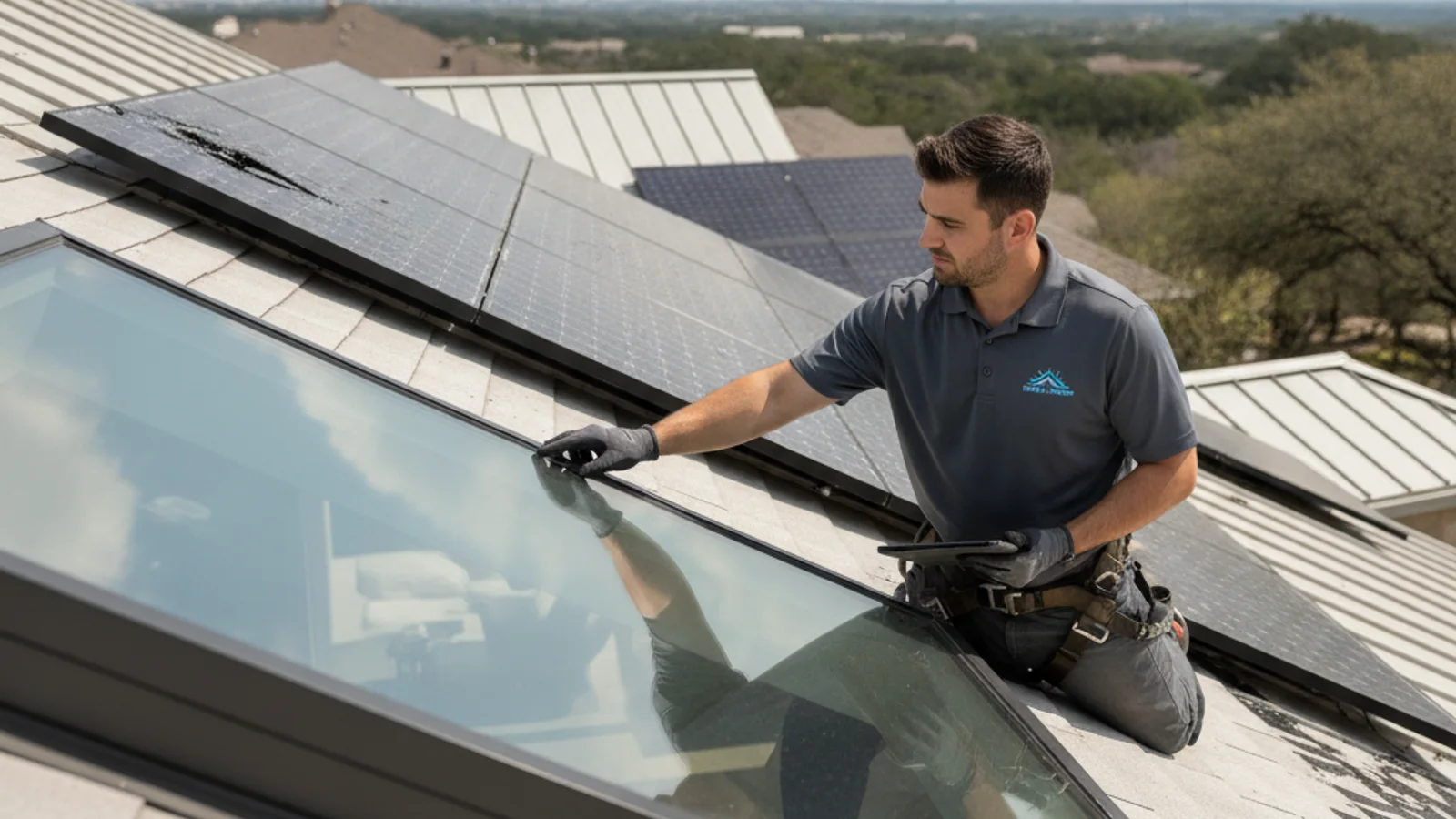
Hail damages glass and acrylic skylight domes differently than it damages composition shingles. Shingles bruise and shed granules under impact. Skylight glazing cracks, spiders, or shatters outright. That skylight damage is often more visibly obvious once you know to look for it, but it doesn’t get inspected as carefully as the roof around it.
Two materials, two failure modes
A composition shingle is a flexible, layered material. A hailstone hitting it dents the surface, knocks off protective granules, and can bruise the mat underneath without breaking through immediately. That damage is often subtle from the ground, which is exactly why roofers walk the whole surface after a storm instead of eyeballing it from the driveway.
Glass and acrylic behave completely differently. Both are rigid materials that don’t flex or absorb an impact the way a shingle does. A hit hard enough to matter tends to crack the surface outright, sometimes in a small spider pattern, sometimes as a clean fracture line across the dome. There’s no “bruised but holding” middle ground the way there is with shingles. Either the impact left a mark or it broke the surface.
Why homeowners see the roof damage but miss the skylight
Here’s the part that catches people off guard: roof hail damage covers a large surface area, so even scattered bruising is likely to show up somewhere a homeowner or an adjuster notices during a walk-around. A skylight is small by comparison, often a single unit on an otherwise unbroken roof plane, and a crack in the dome can be easy to miss from the ground, especially on a steep pitch or a two-story roof.
The stakes are backwards from what that visibility gap suggests. A cracked skylight dome is a more urgent problem than scattered shingle bruising, because it’s a direct opening for water the first time it rains, not a slow-developing wear issue. Smaller area, bigger urgency, and it’s the one most likely to get skipped in a quick post-storm look.
Solar tube domes face the same question, at a smaller scale
Everything here about skylight glass applies to solar tube domes too, just on a smaller physical footprint. A solar tube’s acrylic dome is typically curved rather than flat, which does help it shed some direct hits better than a flat pane, but a large enough stone still cracks or punctures it the same way. Because a solar tube dome is smaller and lower-profile than a full skylight, it’s even easier to overlook during a ground-level post-storm check, which is exactly why it deserves the same deliberate inspection as a full skylight rather than being assumed fine by default.
What to check after a hailstorm
Walk the skylight and solar tube domes specifically, not just the roof plane around them, and look for a few things. Cracking or spidering across the glass or acrylic surface is the clearest sign. Dented or dinged metal cladding and flashing around the unit’s perimeter is another. And keep an eye out over the following weeks for fogging between panes on a double-glazed unit, which can mean a seal took an impact hard enough to break without visibly cracking the glass at the time.
If you can’t get a safe, direct look at the dome yourself, that’s a reasonable thing to ask a roofer or skylight repair technician to check specifically while they’re already up there assessing the roof.
Austin’s storm record, in real numbers
Austin sits inside what roofers here call hail alley, along the I-35 corridor, and the recent record backs up why this question comes up so often. The September 24, 2023 storm brought hail from baseball to softball size and caused more than $300 million in damage, the costliest hailstorm in Austin’s history. May 9, 2024 brought hail up to 3.25 inches. May 28, 2025 brought golf-ball-to-baseball-size hail with gusts up to 80 mph. The metro logs roughly 145 hail reports within 10 miles since 2004, a rating of very high frequency. If your home took a hit during any storm in that stretch and you haven’t had the skylights or solar tubes checked specifically, that’s worth closing the gap on.
Why domes and shingles are built from such different materials
It helps to understand why this difference exists at all. Asphalt shingles are engineered to be somewhat flexible on purpose, layered with a fiberglass mat and mineral granules that absorb and disperse impact energy across a small area rather than concentrating it at one point. A skylight dome, whether acrylic or tempered glass, is engineered for optical clarity and weather sealing, not impact absorption in the same way. That’s not a design flaw in the skylight. It’s simply a different engineering priority, and it means the two materials respond to the exact same hailstone in genuinely different ways.
What an adjuster typically looks for, and where skylights fit in
Insurance adjusters walking a roof after a hail claim are usually trained to assess shingle damage first, since that’s the larger surface area and the more common claim type. A skylight or solar tube on that same roof doesn’t always get the same close attention unless a homeowner specifically flags it or the adjuster happens to notice visible cracking during the walk. This is part of why it’s worth pointing out any skylights or tubes directly to whoever is inspecting the roof for an insurance claim, rather than assuming they’ll be covered automatically as part of the general roof assessment. If you’re navigating that claims process specifically, the fuller breakdown of how a hail claim typically resolves is worth reading in a separate post on skylight hail damage and insurance.
The cumulative effect of repeated storms
Austin’s hail exposure isn’t a single-event risk. It’s a repeated, seasonal one, with multiple significant storms most years along the I-35 corridor. A skylight or solar tube dome that took a glancing, non-cracking hit in one storm can be more vulnerable in the next one, since a hairline stress fracture that didn’t fully crack the surface the first time can propagate further under a second impact. That’s part of why an older skylight that’s weathered several hail seasons is worth a closer look after each new storm, even if it looked fine after the last one.
The re-roof moment
A hail-driven re-roof is the single most common moment this question actually gets asked. Once the shingles are getting replaced anyway, it’s the natural point to have any skylight or solar tube on the same roof inspected, and often to have it swapped or upgraded during the same job rather than as a separate, later trip up the ladder. If a re-roof is already on the table, it’s worth reading through what adding a skylight during a roof replacement actually looks like before the crew starts.
Does hail crack skylight glass more easily than it damages a roof?
Not more easily, but differently. Shingles absorb an impact as surface bruising and granule loss, which is subtle and spread across a large area. Skylight glazing is rigid and tends to crack or shatter outright from a hit hard enough to matter, which is a smaller, more localized, and more urgent kind of damage.
Can a skylight look fine after hail and still be damaged?
Yes. A hairline crack can be hard to spot from the ground, and a seal impact severe enough to eventually cause fogging between panes doesn’t always show visible glass damage right away. That’s why a direct, close-up look at the dome matters more than a glance from below.
Should skylights get a separate hail inspection from the roof?
It’s a reasonable ask. A general roof inspection covers the shingle field well, but a skylight or solar tube dome is a different material with a different failure pattern, and it’s worth specifically asking whoever inspects your roof after a storm to check the unit itself, not just the shingles around it.
Getting it checked
If your roof took a hail hit in any of the recent storms and you haven’t had the skylights looked at specifically, that’s a quick thing to close out before the next storm season. Bright Sky ATX connects Austin homeowners with experienced, insured local crews for skylight repair and skylight glass replacement alike. Call (737) 477-8898 for a free estimate.