A west-facing skylight in Bee Cave earns its keep until midafternoon, then it dumps heat and glare into the room below. Lakeway and the Highway 71 corridor see the same swing: live oaks shade the yard, not the roof glass. Motorized skylight shades close that glass when you cannot reach a wand, and they do it before the great room is already hot.
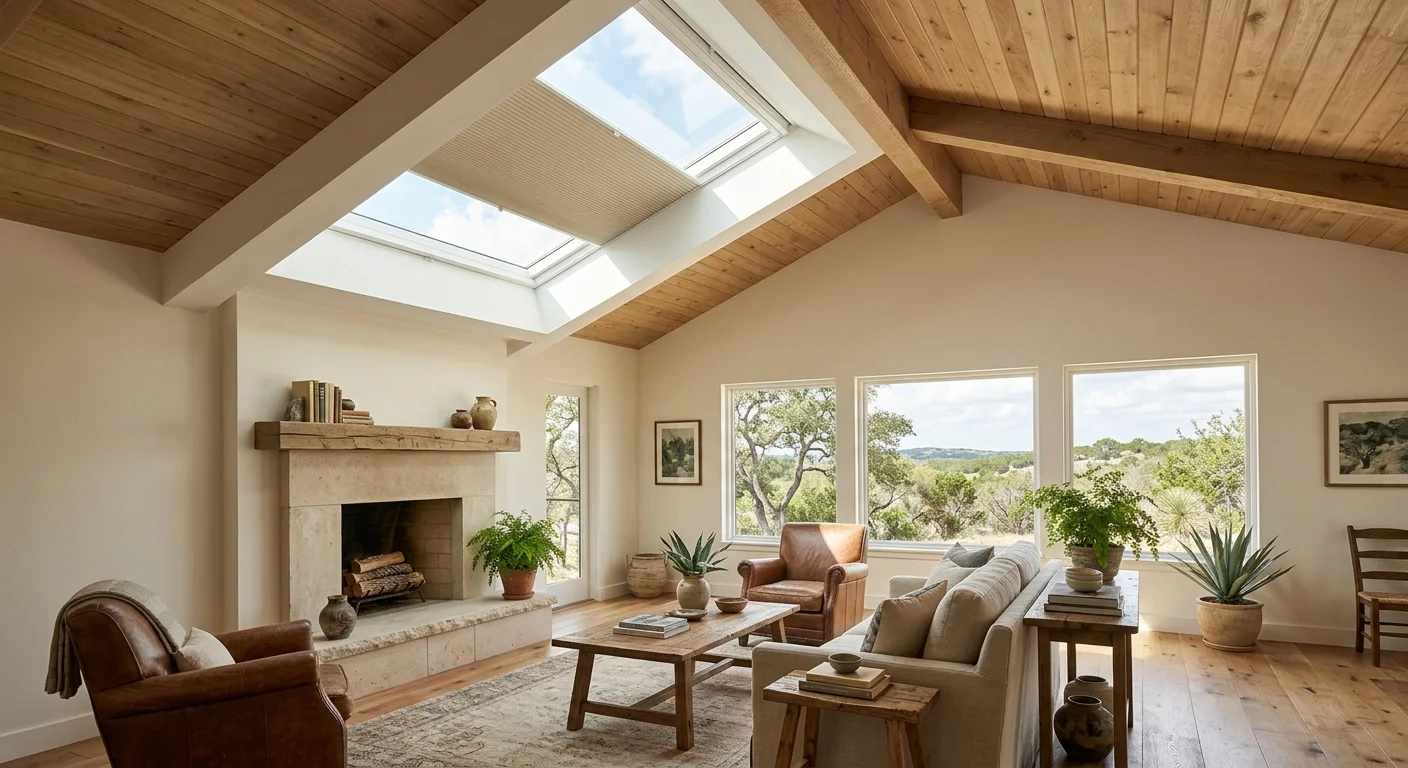
Why west Austin glass overheats a room
Bee Cave sits on the Hill Country side of Travis County, up the 71 and 620 corridors, where lots open to the west and the sun has a long, clean shot at the roof. Lakeway next door is the same country: limestone, live oak, and two-story great rooms with glass in the ceiling. Those oaks cool the patio. They do not cool a skylight.
Wall glass on the west side is a known problem. Roof glass is a different one. Midday sun in Central Texas stands high, so an overhead pane takes a direct hit for hours. Late day, the sun drops and slides in from the west. A room that felt bright at lunch starts to glare, then to bake. That swing is why people look for motorized skylight shades Bee Cave homeowners can actually use. They already have the light. They need a way to shut it off from the floor.
East Austin bungalows sit in a tighter street grid, with neighboring roofs and trees cutting some of that western sky. West Austin is more exposed. A Bee Cave or Lakeway lot often looks at hills, not at the next two-story wall. The well over the living room, the stair, or the upstairs landing is the opening that cooks first, because nothing next door blocks it.
An interior shade sits on the room side of the glass. It cuts glare on a screen and it stops some of the heat that would otherwise land on the floor. It does not replace the glass itself. Heat that has already come through the pane is heat the room has to deal with. If the unit is old, clear, or poorly rated, shade cloth is a comfort tool, not a new skylight. Aftermarket film on the glass is a different object again. Window tinting for Austin skylights is that split.
City of Austin residential energy code uses Climate Zone 2. For skylights, the published maxima are U-factor 0.60 and SHGC 0.28, in the 2024 tables for existing buildings and new construction. Bee Cave is its own city. Those Austin figures do not automatically apply inside Bee Cave city limits. Confirm the current energy rules with the City of Bee Cave building official before anyone orders glass. For the pane itself, the ENERGY STAR criteria for windows, doors, and skylights are a clean product checklist. The U.S. Department of Energy’s heating and cooling guidance is the right place to read how solar gain moves through a roof. The Texas State Energy Conservation Office publishes Texas-facing energy guidance if you want a state source.
If the glass is the weak point, that is a skylight installation conversation, not a fabric conversation.
When motorized shades beat a manual wand
A wand or a crank is fine when you can reach the well without a ladder. Plenty of Bee Cave and Lakeway skylights sit high over a stair, a landing, or a two-story living room. Nobody pulls that wand at 3 p.m. on a July weekday. The shade stays open. The room overheats. Then someone climbs a ladder after dinner.
Motorized skylight blinds and shades earn their keep on those high wells. You close the cloth from a remote, a wall switch, or a phone, from the floor. That is the whole point. It is not a gadget for its own sake. It is the only way the covering gets used on the days it matters.
A motor also lets you close the shade before the sun hits, not after the sofa is hot. West glass on this side of town rewards that habit. A scheduled close in the early afternoon, set once, is the difference between a room you work in and a room you abandon until dusk. Confirm with the product sheet whether the motor you are looking at supports a timer, a sun sensor, or both. Bright Sky ATX does not sell a brand and does not set those specs. The contractor you are matched with should bring the sheet, not a memory of last year’s catalog.
Power is a real choice, and it belongs on the quote. Battery packs avoid a new wire in an existing well. Hardwired motors need a circuit, and electrical tie-ins in Texas are TDLR-licensed work. Solar-assist packs sit in the well and trickle charge. They still need a path to light. None of those options has a verified lifespan or a verified charge interval in our claims ledger, so treat any number you hear as a manufacturer claim to check, not as a Bright Sky ATX figure. Ask how the motor is serviced when it dies, and whether the fabric can come down without replacing the whole cassette.
You can motorize one skylight and leave a reachable one on a wand. That split is common in a house that has a high foyer well and a low bathroom unit. Do not assume a kit from a box store is sized for your span. Skylight wells in custom west Austin homes are often out of square. Measure on site.
A motor also means there is no operating cord hanging in the well. For kids, dogs, and a stair opening, that is a daily safety gain, not a catalog extra. Confirm the exact hardware on the sheet. For the difference between a shade cloth and a slatted blind, read our blinds vs shades guide. This page stays on the motor and on west Hill Country glass.
Heat, glare, and home-office video calls
A lot of Bee Cave and Lakeway work-from-home setups sit under that same roof glass. The camera faces a wall. The skylight sits above and behind, or off to the west. By midafternoon the face on the call goes dark and the background blows out. That is glare, not a bad webcam.
Closing a motorized shade on a schedule is how those rooms stay on camera. A solar fabric can cut the bright patch and still leave a usable room, if the product is built for that. A blackout cloth is for sleep and media rooms. Confirm the fabric type on the quote. Openness, color, and the back face (the side toward the glass) all change how much light comes through. We do not have a verified glare-reduction percentage in the claims ledger. Do not accept a round number on a sales card as a measured result for your well. Ask for the manufacturer’s spec sheet and match it to the room you actually use.
Side channels matter on video calls and in bedrooms. A roller that hangs in free air leaks light down both edges. In a west well that leak is a stripe on the wall at 5 p.m. A recessed cassette with channels keeps the cloth flat. That is a fit question, not a brand question. The pro who measures should say whether your well has the depth for a cassette.
If the office problem is the main reason you are shopping, our skylight home-office glare note covers camera angles and glass that a shade will not fix. Sometimes the honest answer is a different pane, a different desk wall, or both.
Heat and glare travel together on this side of Austin, and they do not peak at the same minute. Glare on a screen can start while the room still feels fine. Heat peaks later, after the well has been in sun for hours. A motor lets you close for the screen at 2 and leave it closed through the late-day bake, then open it at dusk. A wand that lives in a closet does not get that sequence.
West-facing skylight shades in a Bee Cave office are doing three jobs at once: cut the hotspot on the lens, keep the desk from turning into a heater, and leave enough daylight that you are not working under cans at 3 p.m. That mix is why fabric choice belongs on the quote next to the motor, not as an afterthought at install.
HOA and product rules you still have to verify
Bee Cave and Lakeway are full of subdivisions with architectural committees. Spanish Oaks, Sweetwater, Falconhead, and the Lakeway associations each keep their own documents. Bright Sky ATX does not have a verified copy of those rules, and we will not guess at them. If your home has an association, pull the current design guidelines and ask the manager, in writing, before anyone orders a fabric they can see from a street, a green, or a neighboring lot.
Interior skylight shades often sit inside the well, out of the roof plane. Some committees still care about the color that shows through the glass from outside, especially on a light roof. Some do not mention shades at all and only review new rooftop glass. That split is why you ask. A verbal “should be fine” at the mailbox is not an approval.
The City of Bee Cave building department is the authority for permits inside the city. Lakeway has its own. Unincorporated west Travis County is a different desk. Hardwired motors, new circuits, and any work that opens the roof are the items most likely to need a look. We could not confirm a published Bee Cave permit trigger that names skylight shades as their own category. Ask the city, and ask the contractor, before the order is cut.
Product claims need the same check. Child-safety language, fire ratings, indoor-only use, and “smart home” compatibility are manufacturer statements. Confirm them on the sheet for the exact motor and the exact hub you own. Voice assistants show up in catalogs. They are not a Bright Sky ATX promise, and they are not automatic on every motor.
If the job also changes the skylight itself, that is a separate review. Associations that already signed off on the glass may still want a packet for a visible cassette or a solar panel on the roof. Get it in writing. Do not treat a neighbor’s install as your approval.
What to compare on a shade quote
Ask for a site measure. Stock sizes fail on out-of-square wells, and west Austin custom homes are full of those. The quote should name the opening, the fabric, the motor, the power source, the controls, and whether side channels are included.
Compare fabric as a set of jobs, not as a color chip. Solar mesh is for glare and a view of the sky. Light-filtering cloth is for a softer room. Blackout is for sleep. A white or reflective back toward the glass is the usual heat-facing choice. None of those labels has a verified dollar savings figure in our ledger. If a quote promises a percent off your cooling bill, treat it as unconfirmed and ask how it was calculated.
Compare the motor as a service item. Who programs the limits. Who comes back if it creeps. Whether the cassette is recessed. Whether you can replace the cloth without replacing the motor. Battery access in a tall well is a ladder problem for the rest of the life of the house. Hardwired is a circuit problem on day one.
Controls should match how you live. A single remote is enough for one well. Several skylights over a great room want grouping. Phone apps and voice need a hub that the motor actually supports. Write that down. Do not leave it as a vague smart-home line.
Price is set by the contractor you hire, not by Bright Sky ATX. We do not publish a shade price, a trip charge, or a discount. For how Austin-area shade work is usually discussed on cost, see our Austin skylight blinds and shades cost page, then get a number for your well from the contractor.
Also compare the glass. If the pane is the reason the room cooks, a shade is a patch. A lower-gain unit through skylight installation is the other half of the decision. Austin’s published skylight SHGC maximum of 0.28 is a City of Austin figure. Confirm Bee Cave’s current rule locally.
Bright Sky ATX is a referral service. We match you with experienced, insured independent skylight pros across the Austin metro in Travis, Williamson, and Hays counties. You contract with the pro. You pay the pro. We do not install, we do not own a warehouse of motors, and we do not warrant the product. Manufacturer warranties, if any, are theirs.
When to call us
High wells, hardwired motors, and any work that touches the roof or a circuit are jobs for a skylight and daylighting contractor, not a weekend ladder. Call us at (737) 477-8898 and we will match you with an experienced, insured local pro.