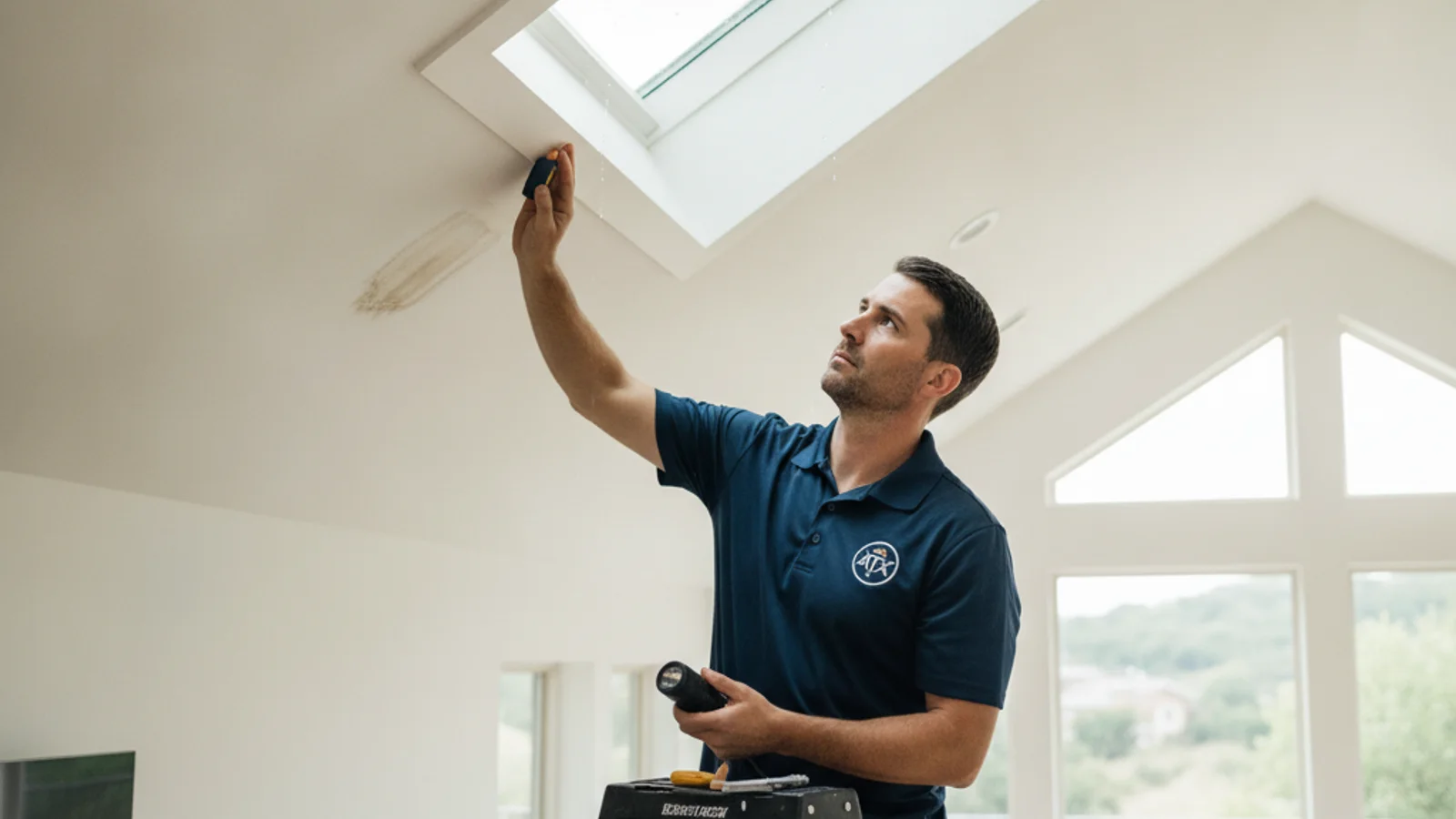
Run the drip-location test first. Water that shows up directly under the skylight after rain is usually the skylight itself. Water that shows up several feet away, along a wall, or only during cold weather often points to the roof or an HVAC line instead. That one distinction saves a lot of wasted phone calls and, more importantly, keeps you from paying for the wrong repair.
Homeowners tend to assume the skylight is guilty the moment a stain shows up nearby, and that’s an understandable instinct. It’s the obvious feature in the ceiling, and water damage rarely announces exactly where it started. But a stain a few feet off from the skylight footprint is frequently the roof doing something unrelated, and treating that as a skylight problem means the actual leak keeps running while someone pays to reseal a fixture that was never broken.
What the drip-location test actually checks
Stand under the affected area and look straight up. If the stain or drip lines up with the skylight’s footprint, the skylight is the likely source. If it’s offset toward a wall, a valley, or a vent stack, something else on the roof is probably feeding water toward that spot, and the skylight just happens to be nearby.
Run through this short checklist before you call anyone:
- Timing relative to rain. Does the moisture show up during or right after a storm, or does it appear on dry mornings too? Dry-morning moisture usually means condensation, not a leak, and chasing it as a leak wastes time and money.
- Drip location vs. skylight footprint. Directly under the unit, or offset to one side? Take a photo from directly below with the skylight in frame, so you have a record to compare against later visits if the pattern changes.
- Staining pattern. A ring around the perimeter usually means flashing or seal failure right at the skylight opening. A streak running toward one corner often means water is traveling from somewhere else on the roof and finding its way to that spot along a joist or the underside of the decking.
- Does it happen on dry mornings too? If yes, run the condensation test in our companion post before assuming it’s a leak at all. A lot of unnecessary repair calls start here.
What “it’s the skylight” usually means
When the skylight really is the source, it’s rarely a mystery. Three things account for most cases: failed flashing around the roof opening, a cracked or spidered dome, or a broken seal that’s let moisture start working its way in. None of these are unusual for a unit that’s been up there a decade or two, and none of them mean the skylight was a bad idea to begin with. Flashing and seals are wear items, the same way weatherstripping on a door eventually needs replacing, and catching the failure early usually means a contained repair rather than a bigger one.
What “it’s the roof, not the skylight” usually means
Sometimes the skylight gets blamed for a problem it didn’t cause. Shingle wear right at the edge of the skylight curb, a nail pop nearby, or valley flashing elsewhere on the roof that happens to funnel water toward the skylight opening can all mimic a skylight leak. Water doesn’t always travel straight down from where it enters; it can run along the underside of the roof deck or a rafter for several feet before finding a gap and dripping into the living space, which is exactly why the stain location doesn’t always match the actual entry point one-to-one. A roofer and a skylight technician are looking for different things, which is part of why this diagnosis sometimes takes more than one visit to nail down, especially on an older roof with more than one potential weak point.
Why Austin’s hail exposure makes this harder
Austin sits on the I-35 hail corridor, with roughly 145 hail reports within 10 miles of the metro since 2004, rated a Very High frequency zone. The area typically sees five to eight significant hail events a year, with the heaviest stretch running March through June. That matters here specifically because a single storm can damage both the skylight and the surrounding shingles at the same time, which means the “is it the skylight or the roof” question can have a real answer of both. If you had recent hail and you’re now seeing moisture, don’t assume one or the other. Get both checked in the same visit, since a repair that only addresses the skylight while ignoring hail-damaged shingles nearby just means a second leak shows up later from the part that didn’t get inspected.
What a repair visit actually checks
A proper inspection doesn’t start and end at the skylight glass. A technician will look at the flashing seams, the seal around the frame, the dome or glass itself for cracks, and the shingles or roofing material immediately around the curb. They’ll also ask about timing, which is why the notes you took during the drip-location test are worth having ready. Expect them to get up on the roof rather than just looking from a ladder at the eave; flashing problems are rarely visible from the ground, and a thorough check usually means direct hands-on inspection of the seams and seals themselves. This is diagnostic work, not guesswork, and a good technician will walk you through what they find rather than just handing you an invoice.
When repair is enough vs. when the unit needs replacing
Most flashing and seal problems are repairable without swapping the whole skylight. A cracked dome or a frame that’s rotted from years of slow leaking is a different story. If the damage is contained to the flashing or a single seal, skylight repair is usually the right call. If the frame itself has failed, it’s worth reading through the fuller repair-vs-replace breakdown before committing either way, since a frame that’s absorbed water for months or years often isn’t worth patching even if the immediate leak can be stopped.
Can a skylight leak be repaired without replacing the whole unit?
In most cases, yes. Flashing repairs and seal replacements are the most common fixes and don’t require removing the skylight itself. Full replacement usually only comes into play when the frame has rotted or the glazing is cracked beyond a simple patch.
How much does skylight leak repair typically cost?
It varies with what’s actually wrong. A reflash or reseal is generally less involved than a full unit swap, and any reasonable quote should tell you which one you’re paying for and why, along with what was found during the inspection that led to that recommendation.
Is a leaking skylight an emergency?
Not usually an immediate one, but it shouldn’t sit for long either. A slow leak that goes unaddressed can damage the ceiling, drywall, or framing around the opening well before the drip itself becomes obvious from inside, and by the time you can see staining spreading across the ceiling, the damage is often already more extensive than what’s visible.
Documenting what you see before the visit
A little documentation goes a long way toward a faster, more accurate diagnosis. Note the date and approximate time you first saw moisture, whether it had rained recently and how heavily, and whether the amount of water seemed to change with the intensity of the storm. If you can safely get eyes on the attic side of the ceiling near the skylight, a photo of any staining on the underside of the roof deck or around the skylight shaft can save a technician real time figuring out where water is actually traveling versus where it’s simply pooling and dripping. None of this requires climbing on the roof yourself, which isn’t something we’d recommend doing regardless of how curious you are about what’s going on up there.
Why the same skylight can pass inspection and still leak later
It’s worth understanding that a skylight can check out fine on one visit and still develop a leak months later, because flashing and seals fail gradually rather than all at once. A seam that’s 90% intact can hold up fine through a light rain and still let water through during a heavier, wind-driven storm. That’s not a sign the earlier inspection missed something; it’s the nature of a wear item that degrades over time under repeated weather cycling. If your skylight has been inspected before and passed, but you’re seeing new moisture now, it’s worth a fresh look rather than assuming the old inspection still applies.
If you’re standing under a wet ceiling right now and not sure which direction the water’s coming from, that’s exactly the kind of call worth making before it turns into a bigger repair. Bright Sky ATX connects Austin homeowners with experienced, insured local crews for skylight installation, repair, and skylight glass replacement. Call (737) 477-8898 for a free estimate.