After a Central Texas storm, water should sheet off a low-slope roof and leave. When it sits against a skylight curb on an East Austin addition or a Dripping Springs terrace, the unit is sitting in the flow. Flat roof skylight drainage is the path around the curb, over the flashing, and out through a drain, scupper, or edge.
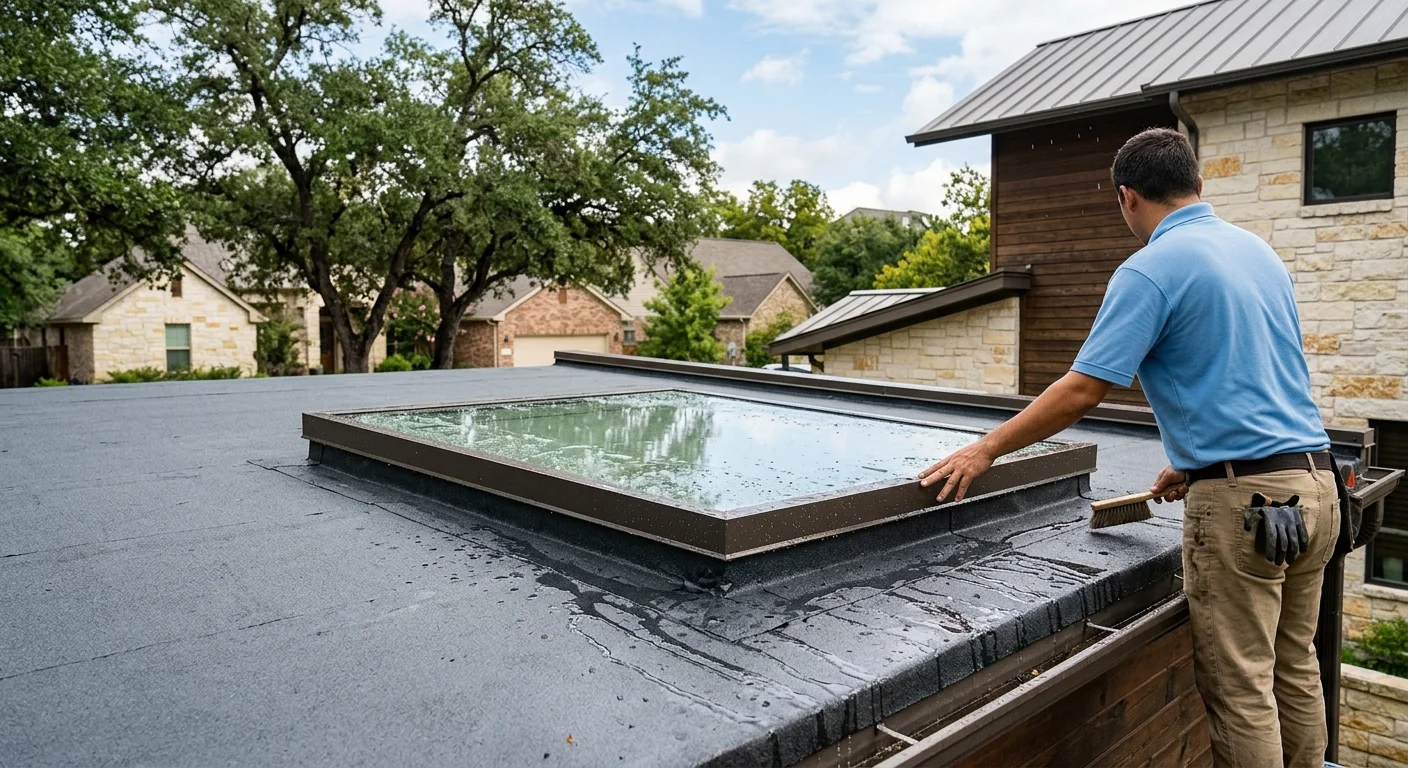
How water moves across low-slope roofs
A “flat” roof in Austin still falls. The slope is shallow, so water moves as a slow sheet. On a steep shingle roof in Hyde Park or Allandale, gravity still clears a few leaves. On a membrane over a family-room addition in Round Rock, Kyle, or East Cesar Chavez, a shallow dip holds water long after the sky has cleared.
That sheet is supposed to travel toward collection points. Those points are interior drains, through-wall scuppers, or an edge gutter. There is no single best drainage system for every house. Interior drains sit in the field and send water down a pipe inside the building. Scuppers cut through a parapet and dump to a downspout or a free fall. Gutters catch the edge. The layout that works is the one that matches the roof’s true low points and keeps that flow moving past the skylight.
A skylight is an island in the sheet. Water that hits the upslope side has to split and go around. If nothing is built to split that flow, water piles against the curb. That is how water pooling around a skylight starts, and it is a common path into a flat roof skylight leak.
Austin weather makes the path unforgiving. Summer cells dump a lot of rain in a short window. The September 24, 2023 hailstorm, the costliest Austin-area hail on record, hit Travis and Williamson counties with about $600 million in losses combined. Round Rock saw hail up to about 4 inches. Ice, broken limbs, and gravel sat on roofs for days. Debris turns a working drain into a dam. A steep roof sheds that mess. A low-slope roof keeps it.
People also ask about drainage requirements for a flat roof. A specific slope, drain size, or curb rule for Austin residential skylights could not be confirmed in our verified claims review. The City of Austin and the building officials in Travis, Williamson, and Hays counties set those standards. Ask the contractor you’re matched with to show how the layout meets the current local rule, and confirm with the city or county before you sign off.
Why curbs and flashing work together
Most units on low-slope roofs sit on a curb. The curb is a framed box that lifts the skylight off the membrane so water can pass. Deck-mounted units sit closer to the roof surface and belong on steeper pitches. On a true low-slope Austin roof, the curb is the usual answer, which is the same split we walk through in curb-mount versus deck-mount skylights.
The curb does not waterproof the opening by itself. Flashing does that. Base flashing, counterflashing, and the membrane tie-in have to wrap the box so water running around it never finds a raw wood edge or a fastener hole. Curbs and flashing fail as a pair. A sound curb with split flashing still leaks. Tight flashing on a curb that sits in a pond still leaks.
Searchers ask where most skylights usually leak. From what you can see indoors, the stain often shows at a corner of the light shaft. The glass can fail after hail, and Central Texas has the scars to prove it. Day to day, water more often enters at the flashing and the curb, especially on the upslope side and at corners where two flashing pieces meet.
That is why skylight flashing repair is its own job. Sealant smeared over a failed flashing line still dumps water at the same seam. The membrane has to be detailed to the curb, clamped or adhered the way that roof system requires, and finished so the sheet sheds away from the opening.
On Hill Country metal west of the city, flashing has to match the panel profile. On a single-ply or built-up roof in Mueller or along the north corridor, the flashing is a membrane detail. Same physics. Different materials. Flat roof skylights in Mueller and East Austin is the planned-community version of that curb. The flat roof skylight assembly only works when the curb height, the wrap, and the roof’s fall all agree.
What ponding water can reveal
Ponding is water that remains after the rest of the roof has drained. From the ground you may see a dark ring around the curb, a wet sheen that lasts into the next afternoon, or algae and grit stacked on the upslope side. From inside, look for a brown tide line on the drywall of the shaft, peeling paint at a corner, or a drip that starts hours after the rain has stopped.
Those signs tell you water is concentrating. A low-slope roof is designed so the lowest point is a drain or a scupper. If the unit is the low point, every storm tests the same flashing line. Standing water also cooks the membrane in Austin heat. It holds grit against the flashing and can keep insulation wet once water has already gotten under the sheet.
Ponding can also reveal a drain that sits proud of the roof, a scupper cut above the real low spot, or a missing split in the flow on the high side of the curb. You cannot confirm those from the yard with certainty. You can see the pattern. Water that always collects on one side of the glass, with a stain that always maps to that side of the shaft, is a drainage clue.
After the 2023 hail across Travis and Williamson, many roofs held ice and broken limbs. If a skylight started staining that winter, the ice may have bruised the glass, or it may have packed debris against the curb so later storms sat there. Either way, the indoor stain is the safe place to start. Stay off the roof. A wet membrane near a drain can be soft, and a parapet is a fall line.
If the stain grows, or if you can smell damp insulation in the shaft, that is skylight repair territory.
How leaves and debris block drainage paths
Austin trees load low-slope roofs. Live oak drops in spring. Pecans dump in fall. Cedar breaks in wind and leaves mats that do not rinse off. Add gravel that migrates, packaging from a reroof next door, and hail shards, and a strainer or scupper becomes a dam.
A blocked interior drain is hard to see from the street. The first clue is often a longer wet patch around the skylight after a modest rain, or a downspout that stays quiet while the roof still glistens. A blocked scupper is easier. From the yard you may see a dark outlet, a stain down the wall, or water sheeting over the parapet instead of through the opening.
Gutters on a low-slope edge fail the same way. Leaves sit in the trough. Water backs up under the membrane edge and toward the nearest curb. On a South Austin terrace with a live oak hanging over the parapet, that cycle repeats every season.
Do not climb up to clear it. Work from the ground. Watch how water leaves after the next storm. Photograph the wet pattern from the yard or a window. Note whether an overflow is running. The pro in the network can check strainers, scuppers, and the upslope side of the curb as part of a drainage look.
Debris is why a roof that used to drain stops. The membrane did not suddenly change slope. The path got plugged, or a new unit, a solar rack, or a skylight was set across the old flow. Keep the indoor stains and the yard photos. Leave the strainer to someone with safe access.
When a specialist should inspect the assembly
Call for a look when indoor stains map to a skylight after rain, when water pooling around a skylight is visible from the ground, or when a scupper or gutter stays loaded with debris you cannot reach safely. Call as well when you are planning a new unit on a low-slope roof. The drainage path has to be designed around the curb before the hole is cut.
A specialist should see the whole assembly: membrane, curb, flashing, and the drain or scupper that is supposed to take the water. That is the same logic in our guide to flat-roof skylights in Austin. The glass is only one piece.
Stay inside and in the yard. Photograph the shaft, the ceiling below, and the wet pattern on the roof from a window or the ground. Do not step onto a wet low-slope roof to check the flashing. Soft deck near a drain is a real hazard, and a membrane can look intact and still be bruised.
If wind-driven rain is part of the story, our piece on skylight leaks in Austin thunderstorms covers that weather. Drainage failures linger. They stain after the sky has cleared. They sit on the upslope curb.
Bright Sky ATX is a referral service. We match homeowners with experienced, insured independent skylight pros who serve Travis, Williamson, and Hays counties. We do not climb the roof, and we do not set the repair. The contractor you hire does.
When to call us
Ponding against a curb, a stain in the shaft, or a scupper that no longer runs is when this work needs a skylight and daylighting specialist. Stay off the roof and get the indoor stains and yard photos ready. Call us at (737) 477-8898 and we will match you with an experienced, insured independent local pro.